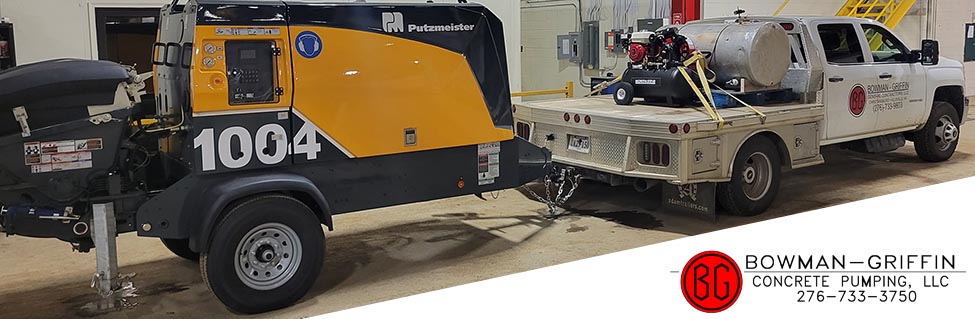
What a trailer line pump is
Our pump is a trailer-mounted line pump. It tows behind a truck, sets up on a flat spot near the ready-mix truck, and pushes concrete through hose instead of dropping it down a chute. The hose is 2.5 inch and 3 inch line. That is the whole idea: the concrete travels to the pour through a hose you can walk, bend, and route around whatever is in the way.
It takes two of us to run it right. One operator stays at the machine, watching pressure, feeding the hopper off the ready-mix truck, and controlling how fast concrete moves down the line. One hose guy stays at the placement end, walking the hose across the forms and laying the concrete where the finishers want it. The rest of the crew screeds and finishes behind them. Nobody is standing around waiting for a chute to reach.
Line size matters more than most people expect. The 2.5 inch line is easier to handle in tight quarters and around corners. The 3 inch line moves more volume for open flatwork. Between the two, we can place footings, basement floors, garage slabs, poured walls, patios, sidewalks and big commercial flatwork with the same machine.
Most crews rent one. We own ours. That is not bragging, it is scheduling. The machine sits on our yard, it goes out when we say it goes out, and we know its history because we are the ones who maintain it. When a pour date moves because of weather, the pump moves with it. Nobody has to call a yard and ask what is available on Thursday.
When a pour needs a pump
Not every pour needs one. If the mixer truck can back up to the forms and the chute reaches, a chute is fine, and we will tell you so. A pump earns its keep in a handful of situations.
If you are not sure which side of that line your job falls on, describe it to us on the phone. We will give you a straight answer, including the times you do not need a pump at all.
- Foundations and footings. Footers, basement floors and poured walls sit below grade or behind a wall, and a chute simply cannot reach the far corner of a footing trench.
- Bigger pours, roughly 8 cubic yards and up. Once the volume climbs, wheelbarrows and chute wrangling start costing you more in labor and finish quality than the pump costs to bring.
- Tight access. Backyard patios behind a gate, slabs between two houses, shop pads at the end of a narrow gravel drive, anything the truck cannot get close to.
- Slopes and hillside sites. Blue Ridge lots rarely give you a flat, straight shot at the forms. A hose goes uphill, downhill and around the corner of the house. A chute goes wherever gravity and the truck allow.
- Soft or finished ground. If the route to the pour crosses a lawn, a septic field, a new driveway or fresh landscaping, keeping a loaded mixer truck off it is worth doing.
What pump day looks like
We show up ahead of the concrete. The pump gets parked on solid ground where the mixer truck can back up to the hopper, usually the driveway or the road shoulder. Then we run hose from the machine to the pour: through the gate, around the house, down the bank, whatever the site calls for. The line gets laid out with the bends kept gentle, because sharp kinks are where hoses plug.
Before any concrete goes through, the line gets primed. A slurry runs through the hose first to coat the inside wall so the concrete slides instead of grabbing. Priming is not optional and it is not a step anybody should skip to save ten minutes. A dry line is how you get a plug, and a plug in the middle of a pour costs everybody on site their morning.
Then it is steady work. The operator matches pump speed to how fast the crew can screed and finish. The hose guy places concrete in the forms in the order the finishers want it, usually the far end first so nobody has to walk back through wet concrete to get out. On a slab we place, screed and bull float in a rolling sequence instead of dumping it all and chasing it.
When the last yard is placed, we clean out. The line gets blown clear, the hopper gets washed, and the washout goes where we agreed it would go before the pour ever started, not into your yard and not into a storm drain. We coil hose, hook up the trailer and get out of the finishers' way while the slab sets up.
Two ways our pump shows up
The first way is on our own work. When we form, pour and finish your driveway, patio, shop slab or foundation, the pump is part of the job, not a separate outfit sending you a separate bill. Because we own the machine and our own guys run it, pumping is built into one price on our pours. There is nobody else to schedule, no waiting on somebody else's window, and no second phone number to chase when the ready-mix truck shows up early.
The second way is for other contractors. We sub the pumping. Our pump, our operator, our hose guy, on your pour. We do not hand the machine over to somebody else's crew and we do not turn it loose without us on it. You get the work done, not a machine dropped in your lap. You keep your pour, your mix, your finishers and your schedule. We show up, place concrete where your crew wants it, clean out and leave.
That works for builders and general contractors who pour a few foundations a year and have no reason to keep a machine parked on their yard the rest of the time. It also works for crews who already own one and have it tied up on another job that week.
Either way, the mix conversation happens before the truck is ordered. We spec strength to the load, and for most work in this climate that means a 4,000 PSI air-entrained mix built for Virginia freeze-thaw. Air entrainment gives the water somewhere to go when it freezes. A pumpable mix and a good mix are not in conflict, but they do have to be ordered on purpose.
Keeping the truck off your yard
A loaded ready-mix truck is heavy. Drive one across a lawn in Carroll County red clay after a wet week and you leave ruts you will be fixing all summer. Run it over a septic field, a leach line, a water line or a new driveway and the damage goes a lot further than sod.
Hose does not do that. It weighs what two people can carry, it fits through a standard yard gate, and it lays on top of the grass instead of sinking into it. On a backyard slab we usually park the truck on the driveway, run line around the side of the house, and place the whole pour without a wheel ever touching the lawn.
Gravel drives are common in the county and they are a real consideration. A loaded truck on soft gravel after rain digs in, and getting it back out can chew up more of the drive than the pour was worth. If your drive is long, soft or steep, that alone is often reason enough to pump from the road.
Same idea inside the building. For basement floors and garage slabs we run line through a doorway or a window opening and place concrete on the inside of a wall the truck will never see. For footings we walk the hose down the trench and fill it in one clean pass instead of shoveling concrete sideways from wherever the chute happened to reach.
On hillside and bank lots, which is most of what this region hands you, the pump matters even more. Concrete moves through the line under pressure, so it does not have to run downhill off a chute. The truck can sit up where the ground is solid and the pour can happen well below it.
Line pump or boom pump
People sometimes ask why we do not run a boom pump. Fair question, and the honest answer is that the two are built for different jobs. A boom pump is a truck with a folding arm that reaches up and over. It exists for high-rise work, long vertical reach, and pours where concrete has to be placed over a building instead of around it. On a tower or a multi-story deck, that reach is the entire point.
The work in this part of Virginia is mostly ground level and near ground: footings, basement floors, garage and shop slabs, driveways, patios, sidewalks, poured walls and commercial flatwork. For that work a line pump places concrete exactly where it needs to go, through hose a man can steer by hand. No outrigger pads, no swinging arm to clear over a roof, no waiting while a much larger machine gets positioned on a residential street.
A boom is the right tool when you need concrete up and over something tall. Short of that, a line pump does the work with less setup, a smaller footprint and better control at the placement end. That is why we own the machine we own.
Contractors: get the pump on your schedule
If you pour foundations, flatwork or slabs and you want the pumping handled, call and put it on the calendar. Tell us the date, the address, the yardage, the mix and what the access looks like. We will tell you straight whether a line pump is the right call for that pour, and what we need from your side to keep the day moving.
We work anywhere within about a 1 to 1.5 hour drive of Hillsville: across Carroll, Grayson, Wythe, Pulaski, Montgomery and Floyd counties, up into the New River and Roanoke valleys along the I-77 and I-81 corridors, and across the North Carolina line into Mount Airy and Surry County. Not sure if you're in range? Call to confirm your address.
- Solid ground for the pump, and clear room for the ready-mix truck to back up to the hopper.
- Water on site for priming and cleanout, plus a washout spot agreed on before anybody starts.
- Your finishers ready when the concrete is, because the pump can move faster than a crew can screed.
- Enough notice that we can fit your pour in around ours. Foundation weather fills the calendar up fast.