Everything that is settled before we start
This page picks up where the quote leaves off. If you are still at the stage of wanting a number, the visit, the measuring and what ends up itemized on the written page are all covered on our free estimates page, along with the installed ranges we work from. Read that one first, then come back here for the pour itself.
What matters here is that three decisions are already closed before a single truck gets booked. The shape and the thickness, which set the yardage. How the concrete reaches the forms, either straight down the chute or through our own line pump, which decides where the crew stands and what has to be cleared out of the way. And the finish you picked, because that sets how long the crew stays after the last load leaves.
Once you sign, those stop being open questions. Nobody is standing in your yard on pour morning arguing about where the joints go. If you want to walk through any of it again before you commit to a date, call 276-733-3750 during shop hours, Monday to Friday, 7:30a to 4:30p, and you get the people who pour the concrete.
Getting on the schedule
Once you approve the estimate we get you on the calendar. Two things drive that date and neither one is our preference: the weather and the ready mix plant.
We pour most of the year here and work around the forecast, not the season. Rain on green concrete ruins a finish, and a slab that freezes before it sets is a slab you pour twice. In summer we start early.
Loads get booked ahead and the good pouring days fill fast, so tell us early. If weather pushes the date, we call you. The pump moves with us, because it sits on our own trailer in our own yard.
Site prep, forms and steel
Prep is where a slab is won or lost, and most of it happens days before any concrete shows up. Those days are also the time to ask us whether we call 811 before a pour. The pre-pour clock puts the permit, the locate and any inspection in order. The outline gets staked first, so the real footprint is sitting on the ground where you can look at it and change your mind cheaply. Sod and the soft dirt under it come off. The grade gets cut to a pitch that carries water away from the house instead of back against it. Crushed stone follows, spread and then packed until it stops moving underfoot. On clay ground that base is the difference between a slab that sits still and one that does not.
Then the forms go up, staked hard enough that a loaded chute cannot shove them out of line, because whatever shape, depth and fall they hold is the shape, depth and fall you are going to live with. Steel is last. Mesh or rebar gets tied into a grid and lifted onto chairs, so it ends up buried at the right height in the pour rather than pressed down against the stone where it does nothing at all.
Pour day
We are usually on site early, before the first load. The ready mix truck comes out from the plant and either backs to the forms and pours down the chute or discharges into our own line pump.
When the pump comes out, it is our own trailer line pump on 2.5 inch or 3 inch hose, with one of our men at the machine and another walking the placing end. That hose is what gets concrete through a side gate, down a narrow side yard, or into a back corner of the property no loaded truck is ever going to reach. Most crews have to go find that machine somewhere else. Ours is already hitched up.
What we need from you is short. You do not have to be home all day, but be reachable. Once concrete is placed, the clock is running.
- Leave room for a loaded truck to get in and turn around.
- Move vehicles, trailers, grills and planters off the work area and the hose path.
- Unlock the gate and keep dogs inside for the day.
- Point out anything buried: irrigation, invisible fence, septic, propane, low voltage.
- Give us a spigot for finishing and washout.
- Keep kids and pets clear of the forms until the crew is off the site.
Finishing, joints and the cure clock
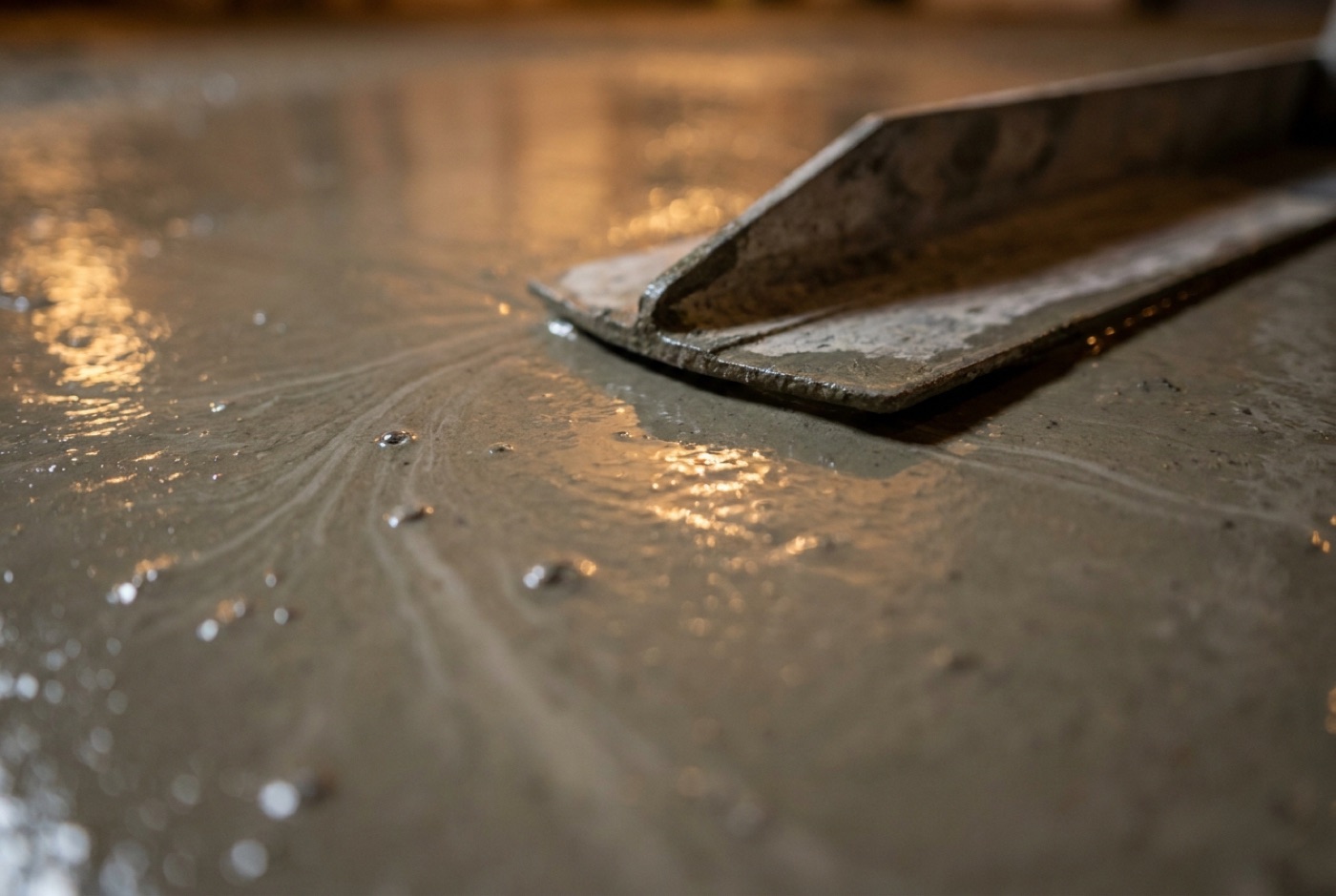
Finishing is not a separate visit. It happens within hours of the last truck, on the same day, because concrete will not hold still and wait for a better morning. The crew screeds to grade, floats the surface, tools the edges, then stands back until the slab firms into the window where a finish will take. That timing gets read off the concrete, not off a clock.
Then the finish you picked at the estimate gets put on. A broom drag gives traction and is right for a driveway or a walk. A troweled surface is smoother and belongs inside. Stamped work gets pressed in while the slab is still workable.
Control joints get cut within the first day, on a spacing that suits the slab, so shrinkage lands in a cut line you chose instead of wandering out across the open field of the pour. Concrete relieves stress somewhere. Joints tell it where.
Then the waiting. You can typically walk on new concrete in 24 to 48 hours and drive on a residential driveway after about 7 days. It reaches full strength around 28 days. We give you exact cure guidance for your pour and the weather it went down in.
The walkthrough and the warranty in writing
The forms come out, dirt goes back against the edges, and everything we brought onto the property leaves with us. Then we walk the finished job with you and look at the surface, the edges, the joint lines, and where water will run.
We also tell you what to expect out of the first month. Roll onto a new slab gently, and do not crank the steering wheel with the vehicle standing in one spot. Keep truck and trailer tires off the outside edges. Leave the de-icing salt in the bag through the first winter and reach for sand instead.
There is a workmanship warranty, terms confirmed on the written estimate, so you are holding them well before the crew ever shows up. A thin hairline right at a control joint is the slab doing exactly what a joint is for. Base that settles under a slab we prepared, or a surface our crew finished badly, is on us. Call and we will come look.