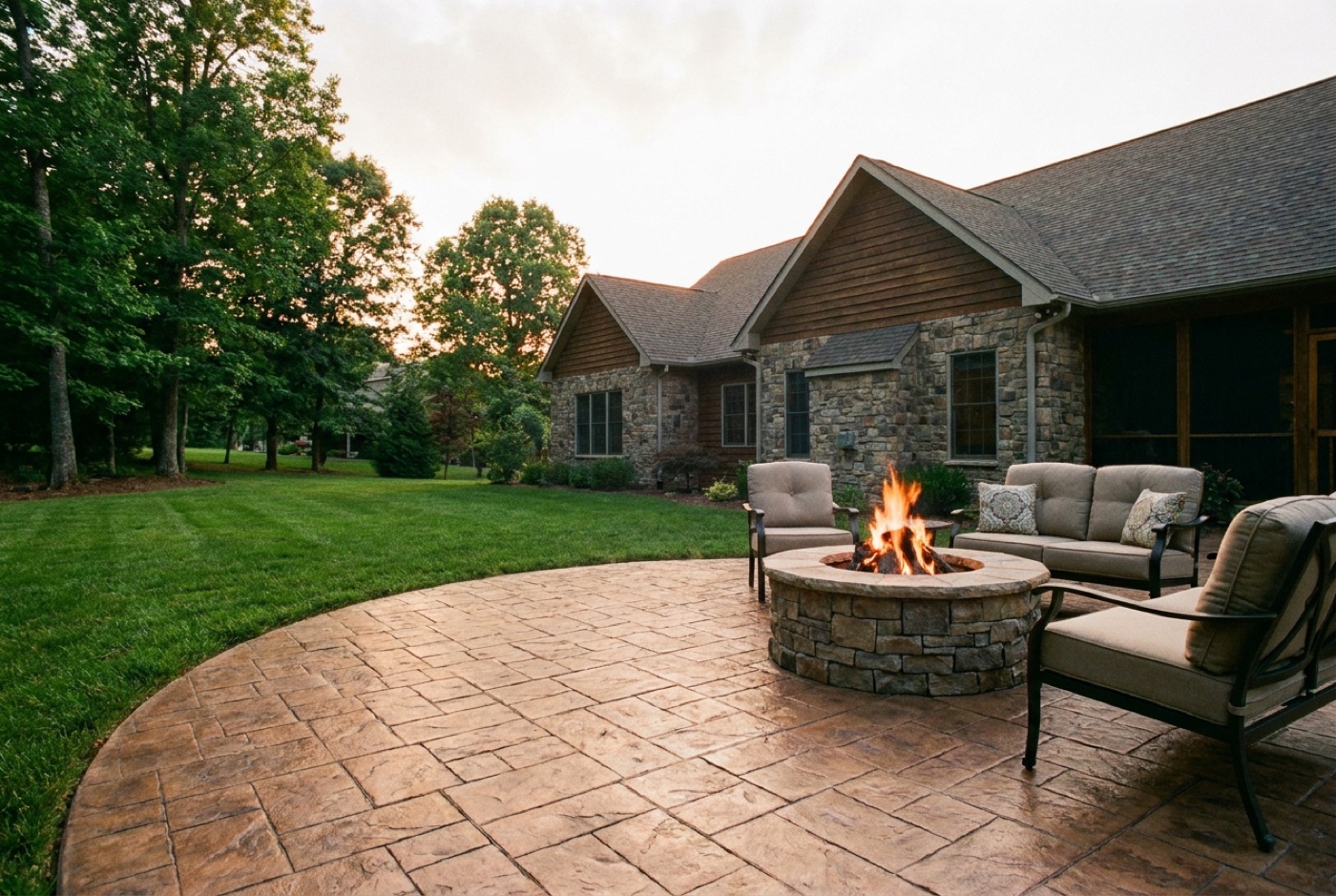
Start with how you want to use it
Before we talk finishes or square feet, figure out what is going on the slab. A table and four chairs takes less room than most people picture. A table, a grill, and standing room for whoever is cooking takes a lot more. Set the patio furniture you already own out on the grass and live with it for a day. That footprint, plus about three feet of walking room on every open side, is usually the right patio.
Rectangles pour cheapest. They form fast, the joint layout is simple, and the finish crew can keep a clean edge all the way around. L shapes work well when the patio has to wrap a corner of the house or step down off a back door. Curves look sharp and we build them, but every curve is formed by hand, so it takes longer and it shows up on the estimate. If the budget is tight, keep the shape square and put the money into square footage or into the finish.
- 10 by 12 feet: small table, two or three chairs, room to walk past
- 12 by 16 feet: full dining table for six with the chairs pushed back
- 16 by 20 feet and up: dining area plus a separate seating or grill zone
- Add three feet of clear walking room on any side that stays open
- Add a four to six foot apron in front of a grill or an outdoor kitchen run
- Line the patio up with the door and the sight line from inside the house
Broom, stamped, or exposed aggregate
Broom finish is the workhorse. Once the slab is floated, we drag a broom across it to leave a fine, even texture. It sheds water, it gives grip when the surface is wet, and it never fights with the house for attention. Broom finished patios and walkways at 4 inches run $9 to $14 per square foot installed. Where you land in that range depends on access, how much tear out there is, thickness, and how much hand forming the shape needs.
Stamped concrete is the same slab with color worked in and a texture pressed into the surface while the concrete is still plastic. Ashlar slate, seamless stone and wood plank patterns are the common ones, and a border in a second pattern makes a plain rectangle look deliberate instead of poured. Stamped and decorative work runs $14 to $22 per square foot, a band worked out in dollars, cubic yards and loads on a small patio and a larger one. Exposed aggregate sits between the two. We wash the surface cream off while the slab is green so the stone in the mix shows through. It wears well, it hides dirt, and the texture underfoot is grippy without being rough.
Whatever finish you pick, we spec the mix to the load and to the weather it has to live in. For outdoor flatwork in this part of Virginia that is commonly a 4,000 PSI air entrained mix. Air entrainment puts microscopic bubbles through the paste and gives freezing water somewhere to expand. On a patio that sees snow, ice and a forty degree swing inside one week, that mix decision matters more than anything you put on top of it later.
Fire pits, hot tubs, and grill pads
A hot tub is a serious concentrated load once it is full and there are people in it. We pour a thicker pad under it, usually 6 inches with reinforcement, and we set that pad while we are forming the rest of the patio so the whole thing comes out as one continuous surface instead of a patch dropped in later. Tell us the model, or at least the filled weight, before we form. Thickening a pad after the fact means saw cutting a finished slab and pouring twice.
Placement matters as much as thickness. Leave one side of the tub open with clear access for equipment service. Keep the tub off the low corner where the patio drains. Run the electric before the pour, not after. A conduit sleeve is cheap while the forms are still up and expensive once the slab is down.
Fire pits are simpler, but they still want planning. A built pit needs a solid, level base and enough clear apron for chairs, generally five to six feet out from the outside face of the pit on every side people sit. Portable pits sit fine on a standard 4 inch patio, though repeated direct heat will discolor concrete over time, so a pad or a set of pavers under a wood burner is a reasonable thing to do. Grills are the same story. The slab handles the weight, but grease stains, and sealer is what saves you.
Slope, drainage, and the base underneath
Water is what ruins patios, and worse, it is what ruins the basement behind them. Every slab we pour tips away from the house. The working number is about a quarter inch of fall per foot, so a 16 foot deep patio drops roughly four inches from the house wall out to the front edge. That is enough to move water off the surface and shallow enough that a table still sits level and nothing rolls off the far side.
Where the water goes after it leaves the slab matters just as much. In red clay, water that gets under a slab has nowhere to soak away, so it sits, and in January it freezes and lifts. We build on a compacted base and we look at whether the yard past the patio carries water somewhere useful or dumps it back at the foundation. On sloped Blue Ridge lots the answer is often a step down or a low edge instead of one giant flat plane. We walk all of that with you when we come out to measure.
Slabs move whether you plan for it or not. Concrete shrinks as it cures, then expands and contracts with temperature every year it exists. We control that with joints: saw cut or tooled control joints at a spacing set by the slab thickness, plus isolation material where the patio meets the house wall, a stoop, or a post footing so those pieces can move on their own. Joints do not stop concrete from cracking. They decide where the crack goes, and a crack that lands in a joint is one nobody ever notices.
Steps, stoops, and tying into the walkways
Most patios have to connect to something. The back door sits above grade, so there is a stoop or a short run of steps. A side path needs to reach the driveway. Doing that work on the same trip is cheaper than bringing a crew back later, and the color and finish actually match, because it comes off the same pour with the same hands on it.
We keep step risers consistent. Uneven risers are the reason people trip on their own back steps in the dark. Treads get the same slight fall as the patio so water leaves instead of standing and freezing. The nosing gets a rounded edge that stands up to a snow shovel. If you want a handrail, tell us before the pour so the anchors get set or sleeved while the concrete is wet.
Walkways are usually three to four feet wide. Three feet handles a simple side path to the driveway. Four feet lets two people walk side by side, and it is the width that makes a front walk look like it belongs to the house instead of looking like an afterthought. Walkway flatwork at 4 inches carries the same $9 to $14 per square foot installed range as a patio, and stamping the walk to match a stamped patio is what pulls the whole yard together into one piece of work.
How the pour goes, and the gate problem
The process does not change much job to job. We lay the shape out on the ground and confirm it with you before anything gets dug. We strip sod and excavate to grade, then build and compact the base. We set forms, set reinforcement, and check fall in both directions while the forms are still adjustable. Then we pour, screed, float, finish, joint, and cure. On a stamped job the color and stamping happen inside a tight window, which is why stamped work runs with a bigger crew.
Access is where backyard patios stall out. A loaded ready mix truck is heavy, and it is not going through a four foot gate, across a septic field, or over a finished lawn without leaving ruts you will be looking at all summer. Most crews solve that with wheelbarrows, which is slow and hard on the finish, or by driving the truck in and costing you the yard. We solve it with our own trailer mounted line pump.
The pump runs 2.5 inch and 3 inch line. We snake that hose around the house, through the gate and down the side yard while the truck sits on the driveway where it belongs. It is our pump, run by our operator with a hose guy on the end of the line. Most crews rent one. We own ours, so pumping is built into one price on our own pours instead of showing up as a separate line item from somebody else. It also means concrete gets placed fast and at a steady rate, which is what a stamped pour needs so the whole slab reaches the same stage at the same time.
Sealing, salt, and the first year
New concrete wants to be left alone for a while. Keep foot traffic off at first, and keep furniture, planters and anything with wheels off longer. We give you the specific timing for your pour in writing so you are not guessing. Concrete keeps gaining strength for weeks after it stops looking wet, and the surface is the part that cares most about being rushed.
Sealer is worth the money on a patio, and on stamped work it is not really optional. A sealer keeps the color from washing out, keeps grease and leaf tannin from staining the surface, and makes cleanup a hose instead of a scrub brush. Plan on resealing every couple of years, sooner on a patio that bakes in full sun all afternoon. If your patio gets wet often, ask for a grit additive in the sealer so a glossy stamped surface does not turn slick.
In winter, stay off the deicing salts, especially the first year. Rock salt and the chloride blends work at the surface and pit it, and a young slab is the most vulnerable it will ever be. Sand gives you traction without the chemistry. Past that, maintenance is easy. Sweep it, hose it, and make sure your downspouts run past the patio instead of emptying onto it. We back our work with a workmanship warranty in writing, and the exact terms are confirmed on your written estimate.