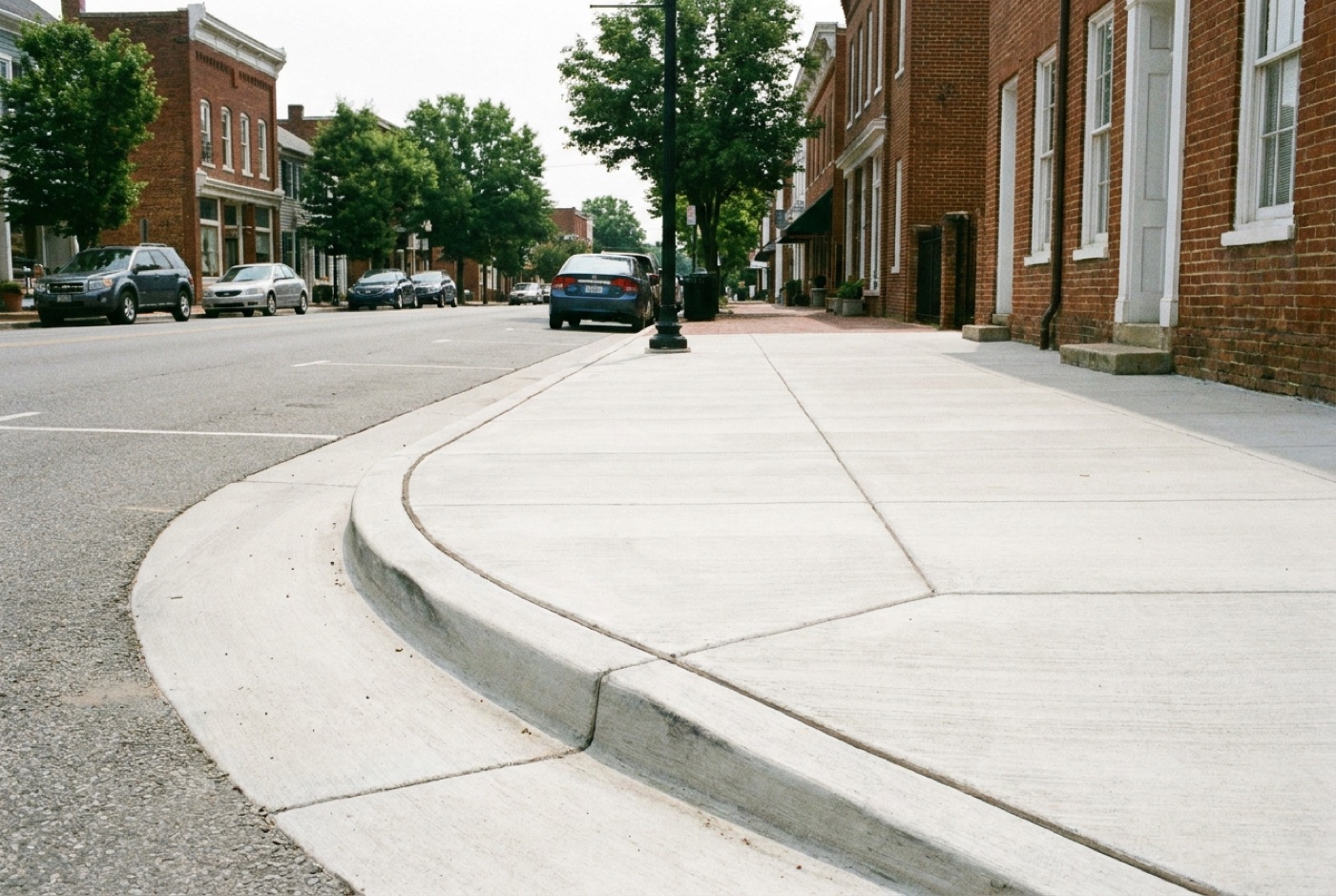
Why a narrow walk carries a band above a driveway
A driveway at 4 inches is $8 to $12 per square foot installed and a sidewalk is $10 to $15, even though the walk is smaller and thinner. The answer is edge. On flatwork the price follows forming and finishing labor more than it follows the volume of concrete, and a narrow ribbon of concrete is almost nothing but edge. A four foot walk has two form boards running its whole length with four feet of slab between them. A twenty foot driveway has the same two boards with five times the surface to spread them across, and its finish crew gets long passes instead of hand work at every turn.
Delivery is the last piece. Ready mix comes in 10 cubic yard loads and a job rounds up to the next full load, with 10 percent added for waste, because forms flex and some concrete always stays in the chute. A short front walk does not come close to using a full load and still carries one. That is why we would rather pour your walk on the same trip as a driveway or patio.
How wide a walk should be and where it should run
Three feet handles a simple side path from the drive to a side door. Four feet lets two people walk beside each other, and it is the width that makes a front walk read as part of the house instead of a strip somebody added later. If the budget is tight, put the money into width rather than into a shape.
Straight runs form fast and finish clean. Curves are built by hand, one board bent and staked at a time, so they take longer and show up on the estimate. Line the walk up with the door and with the way people already cross the yard, or a dirt track gets worn in beside it.
Steps live or die on rise and run
A set of steps is a rhythm. Your foot learns the first riser on the way up and expects every riser after it to match. When one is a half inch off, the leg does not get the report it expected and you stumble. Uneven risers are the usual reason people trip on their own front steps, and it rarely happens in the middle of a flight. It happens at the top or the bottom, where somebody poured to whatever the dirt was doing instead of measuring.
So the numbers get settled before any concrete is ordered. We measure the total rise from the finished landing down to finished grade, divide it into equal parts, and set the forms to those parts. Run gets the same treatment, so every tread is the same depth and a whole boot lands on it. The nosing gets a rounded edge, since a square lip chips and a snow shovel finds it.
Tying new steps to an existing stoop or foundation
Most step jobs are not on bare ground. There is already a stoop, a porch slab or a foundation wall, and the new work has to meet it. Two pieces of concrete poured years apart do not move together, so we isolate them with expansion material at the joint. Where the old concrete is cracked through or heaved, pouring against it ties good work to a failing piece. Tear out and haul off adds $2 to $3 per square foot.
What sits under the steps matters more than most people expect. The ground right against a foundation is backfill, the loosest dirt on the property, and it keeps settling for years. Steps set on it settle with it, which is why so many older steps tip back toward the house and pull open at the wall. We dig through that to firm ground or build a compacted base, and the footing under a flight is sized for what it holds.
Handrail anchors get set before the pour
If you want a rail, tell us at the estimate. Anchors or sleeves go in while the concrete is still wet, set to the post spacing the rail actually needs. That is a few minutes of work on pour day.
Drilling posts into finished steps later works, but it opens holes in the tread surface, and a hole in a tread is where water sits, freezes and breaks the concrete apart around the anchor. If a rail is even a maybe, sleeve it now. How many risers a flight has before a rail is required is your building office or your builder's call, and we form to what the plan asks for.
Drainage, so a landing sheds away from the door
A landing sits at a threshold, which makes it the one piece of flatwork on the property with a doorway on the high side of it. It has to fall away from that door. The working number on outdoor flatwork is about a quarter inch of fall per foot, enough to move water off and shallow enough that nothing feels tilted.
Treads get that same slight fall. A dead level tread holds a film of water, and a film of water at this elevation is ice at exactly the height where your weight transfers. A downspout emptying onto a landing soaks the base and undoes good pitch, so we look at the gutters and the grade past the steps.
Freeze and thaw are hardest on steps
Steps take more weather per square foot than anything else we pour. A driveway sheds. A step holds. Treads collect rain, snow and the melt running off the risers above them, so water sits on the concrete for hours during the part of the year when the temperature crosses freezing overnight and back by afternoon. Every one of those cycles pries at the surface.
That is why the mix matters here as much as the forming. We spec strength to the load, commonly a 4,000 PSI air entrained mix built for Virginia freeze-thaw, and the air content gives freezing water somewhere to expand instead of pushing the surface off in flakes. Steps are also the first place people reach for de-icer. Chloride blends pull water into the surface and run that cycle harder than the weather does alone. Sand gives traction without the chemistry.
Base, thickness and steel under a walk
The part you cannot see decides whether the walk is still flat in ten years. Native ground here is red clay, and clay holds water, swells when it freezes and shrinks when it dries. A walk poured straight on graded clay sits on something that moves all winter, and narrow slabs show that movement sooner than wide ones, since there is less concrete to bridge a soft spot. Crushed stone, compacted in place, gives the slab a base that drains.
Four inches is standard for a walk. Where a vehicle crosses one, we thicken and reinforce for that traffic instead of hoping the standard section holds. Wire mesh works as long as it is pulled up into the slab instead of lying flat on the stone. A tied rebar grid adds $0.75 to $1.25 per square foot over mesh and earns it on long runs, on fill and in steps. Joints get cut or tooled to fit the slab. They do not stop shrinkage. They decide where it shows.
What walks and steps cost, and what the estimate spells out
Sidewalk work runs $10 to $15 per square foot installed. A front walk four feet wide and forty feet long is 160 square feet, so at $10 that is $1,600 and at $15 it is $2,400. Where a job lands inside the band comes down to length and shape, how much hand formed curve there is, tear out, access, and whether the pour can share a trip with other work. Steps are quoted on their own line rather than folded into a square foot rate, since a flight with a landing is forming, bracing, steel and hand finishing.
Some of this work sits where a mixer truck cannot reach: a walk along the back of the house, steps down a bank, a landing on the low side of a lot. We run our own trailer mounted line pump with an operator and a hose guy, on 2.5 inch and 3 inch line, so the truck stays on firm ground and the concrete comes to the forms. Most crews rent a pump when a job needs one. We own ours, so placement sits inside the one price on our own pours.
We measure on site before anything is final, then hand you a free written estimate, usually within a day or two, with the scope, the thickness and the finish spelled out. The workmanship warranty is in writing, with exact terms confirmed on that estimate.