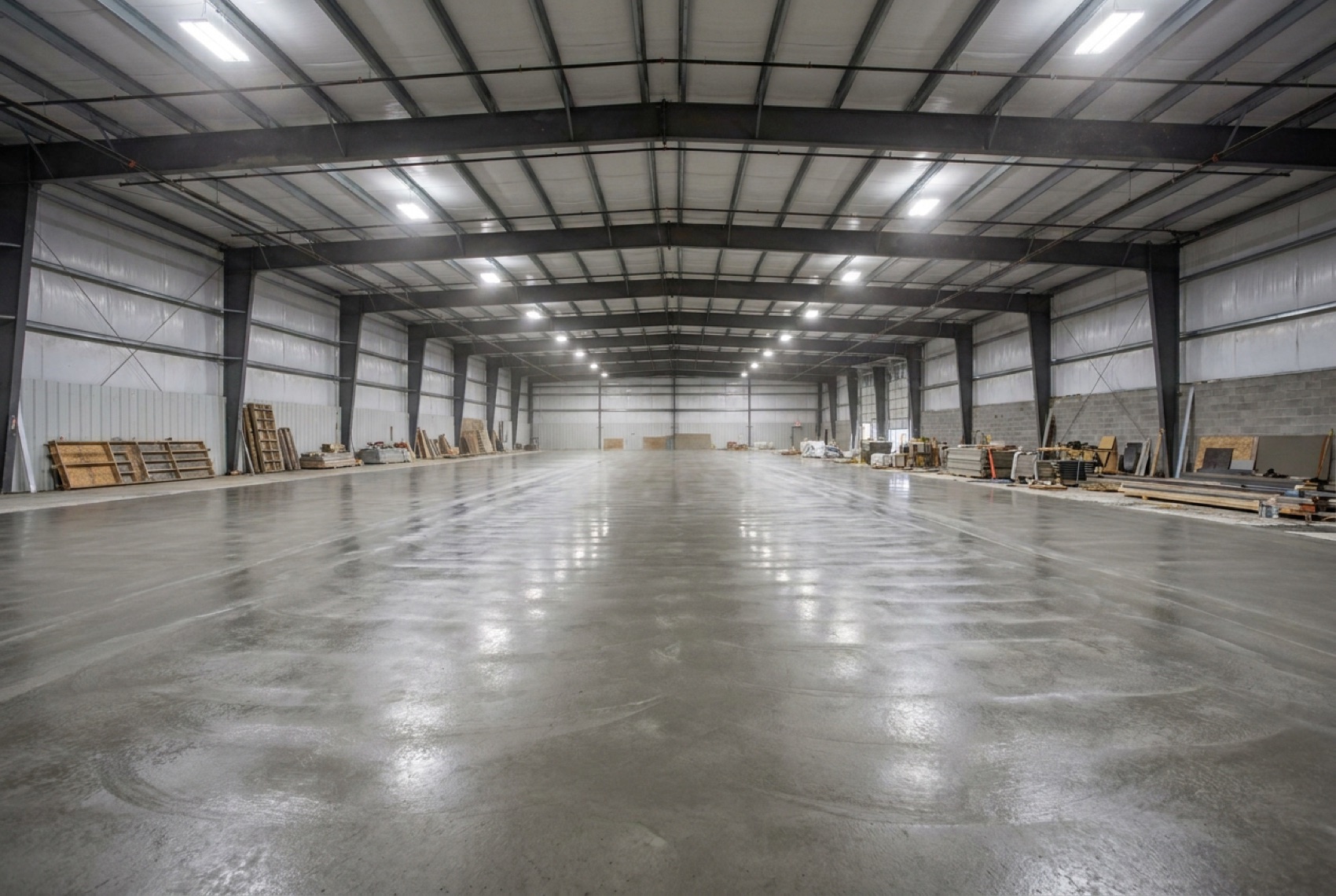
The size of commercial work we are built for
Bowman Griffin Concrete is a family crew out of Hillsville that forms, pours and finishes flatwork. Commercial for us means the concrete around a small business and the flatwork on a builder's site. A parking pad behind a shop or a lot for a dozen cars. The walk along a storefront and the ramp up to the door. A dumpster pad the hauler can set on, an apron where a box truck backs in, a pad under a generator, a building slab for a shop or a pole building.
What we are not is an interstate paving outfit. We are not set up for a highway job or a multi-acre yard poured in a week, and if that is your job we will say so on the phone rather than stretch to it. There is no project list here and no square footage record, because the honest answer to how big we go is a conversation about your site. The work under the surface does not change from a homeowner patio to a commercial pad. What changes is the paperwork above it and the scheduling around it.
Drawings and specs instead of a tape and a sketch
On a residential job we come out with a tape, walk the yard with you, sketch the shape and talk thickness, steel and finish out loud. That works because you own the whole decision. On a commercial job those decisions are often already made, on paper, by somebody who is not standing in the lot with us.
So bring whatever paper exists to the estimate visit. A site plan showing where the pad goes and how big it is. Elevations and slopes. A detail sheet calling out slab thickness, base depth and compaction, mix strength, bar size and joint spacing. Even a landlord's letter about what has to be replaced counts. The more of it exists, the closer the written number lands to the job you actually have.
We still walk the site, because access, subgrade and drainage move a concrete price more than anything else and none of them read accurately off paper. The plan, the permit and the inspection schedule usually stay with the owner or the general contractor, and building permit explains what that paper is. We handle the concrete side, and where an inspection touches that work, the pour belongs after it.
Subgrade and thickness sized to the load that will really park on it
Four inches is standard residential flatwork, and plenty of light commercial work is exactly that. A striped car lot with no truck traffic is not far from a driveway. The trouble starts when the pad takes something a car never does.
A dumpster pad is the clearest example. A roll-off is set down hard, sits loaded for a week, then gets dragged off across the same few feet of concrete, all of it through the container rails and the truck's rear wheels. A loading apron takes the same abuse from a delivery truck turning under load. Slabs like those get more thickness, a tied rebar grid, and more stone underneath.
The base decides whether the pad is still flat in ten years. The native ground here is red clay, which holds water and moves with the seasons. We cut grade, strip soft topsoil, take out the wet spots and replace them with crushed stone compacted in lifts. On a lot the base also has to shed water, because standing water is a complaint you hear every rainy week. Tell us the heaviest thing that will sit on the finished concrete and how often it comes.
Joint layout to a plan, not to a rule of thumb
Concrete shrinks as it cures and relieves that stress somewhere. Joints decide where. On a house that is a spacing judgment we make on site. On a commercial pad the layout is usually drawn, for reasons beyond the concrete.
Isolation joints go where the slab meets something that moves differently: a building wall, a column, a light base, a bollard, a curb, an existing pad. Expansion joints go where the plan puts them. Saw cuts follow a spacing that suits the thickness, and on a lot they also want to agree with the striping and the curb lines. A joint that dies in the middle of a drive lane reads as a mistake to everybody who parks there. Cuts happen within the first day, which is one reason we do not stack a commercial pour on a day we cannot finish.
Phasing and pour windows so the business stays open
A residential driveway means the family parks on the street for a week. A business cannot do that. If the lot is closed the doors may as well be, so the schedule gets built backward from staying open.
That usually means pouring in sections. One half of the lot carries traffic while the other is formed and poured, and the entrance, the fire lane and the accessible spaces stay usable throughout. It costs a little more in mobilization and adds a construction joint where the halves meet, and it is worth both. Barricades stay up through the cure, because new concrete does not care that a delivery driver was in a hurry. Tell us your delivery days and anything on a fixed schedule such as trash pickup, and we pour around them.
The other half of staying open is when the trucks arrive. We start early on pour days as a matter of course, and earlier still in summer, so much of the placing and finishing on a small pad can be done before a storefront opens. Be straight about the window you need and we will be straight about what we can schedule into it. Weather drives the date first, and the ready mix plant second, since loads are booked ahead and good pouring days fill fast in season.
Concrete keeps its own calendar afterward. A slab is generally walkable somewhere between 24 and 48 hours, and a car belongs off new residential concrete until roughly the seven day mark. Full strength lands near 28 days, and on a pad carrying loaded trucks that is the number that matters.
The line pump on a commercial site
We own a trailer-mounted line pump and run it with an operator and a hose guy, on 2.5 inch and 3 inch line. Most crews rent one. Ours is already hitched up in our own yard, so it moves on our schedule instead of somebody else's.
Commercial sites hand us the pours a chute cannot reach more often than houses do. A pad behind a building with a gate between it and the street. A slab inside a shell that is already framed. A finished lot nobody wants ten loaded wheels driving across. A pump usually makes sense when the pour is a foundation, when it runs roughly eight cubic yards or more, or when the site is too tight for a chute. On our own work the placement sits inside the single price you approved rather than showing up later as its own line. When you have your own crew and only need the concrete placed, we sub the pumping for you.
What commercial flatwork costs and how the number gets built
Commercial walks and public-facing sidewalk run $10 to $15 per square foot installed, above a driveway even though a walk is thinner, because a narrow pour is mostly forming, edging and finish labor. If there is old concrete where the new work goes, breaking it out and hauling it off adds $2 to $3 per square foot and shows as its own line. A tied rebar grid instead of wire mesh adds $0.75 to $1.25 per square foot, and on a pad that takes truck traffic it earns that.
Run the arithmetic yourself. 600 square feet of storefront walk at $10 per square foot is $6,000, and at $15 is $9,000. If it replaces a cracked walk, tear-out at $2 adds $1,200 and at $3 adds $1,800. Volume works as it does on any pour: area times thickness divided by 27 for cubic yards, plus 10 percent for waste, ordered in 10 cubic yard loads and rounded up. That rounding is why a small pad costs more per square foot than a big lot.
The estimator on our homepage is built around common residential project types, so it is a fair ballpark for a simple pad and not the right tool for a lot with a plan set behind it. There the written estimate does the work. It spells out area and thickness, site prep and stone base, reinforcement, mix strength, finish and joint plan, whether the pour needs our line pump, and one total. Our workmanship warranty is in writing, with exact terms confirmed on that estimate.