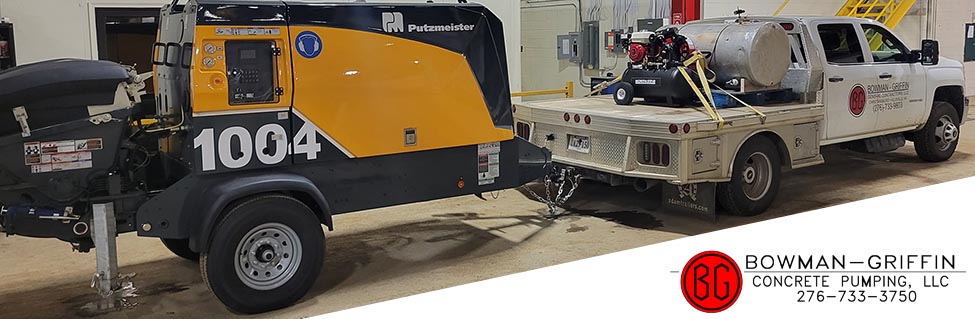
Why a pouring crew bought its own pump
Plenty of concrete crews are good at forming and good at finishing and still have to make a phone call when a pour needs a pump. They book one from somewhere else, take whatever slot they are given, and hope it rolls in on the same morning the ready-mix does. We got tired of standing in that spot. So the pump became ours.
That is the short version. The long version is every job where the weather turned, the schedule slid a day, and the pump was the one piece we could not move. Concrete does not wait on anybody. Once the truck is loaded and rolling, the clock is running and every person on that site is working against it. Owning the pump took the biggest variable out of somebody else's hands and put it back in ours.
It is not a sales angle. It is a tool we bought because we use it, the same as the forms, the screeds, the power trowel and the truck that hauls all of it. We are the concrete arm of a family of Hillsville building companies, and when a piece of equipment shows up on enough jobs, you stop borrowing it and you buy it.
What the rig actually is
Our pump is a trailer-mounted line pump. It tows behind a truck, sets up on the ground somewhere near your pour, and pushes concrete through hose. There is no boom, no arm swinging out over the roof of your house. Other outfits run boom pumps, and on the right high-rise or long-reach job a boom is the right machine. Ours is a line pump, and the concrete goes exactly where the hose goes. The hose goes where we walk it.
We run 2.5 inch and 3 inch line. That range covers the work we actually do. Narrow enough to handle and snake through tight spots by hand, big enough to move real volume on a flatwork pour without choking off the finishers. Footings, basement floors, garage and shop slabs, driveways, sidewalks, commercial flatwork. Same rig for all of it.
It runs with two of ours on it: an operator at the pump and a hose guy at the placing end. The operator watches feed and pressure and keeps the line moving steady. The hose guy walks the concrete to where the finishers want it and calls the pace back to the pump. That is how a pour stays smooth instead of coming in surges, and it is how the site stays clean.
- Trailer-mounted line pump, towed in and set up on the ground
- 2.5 inch and 3 inch hose, added in sections to reach the forms
- Run by our own operator with our own hose guy at the placing end
- Sets up in a driveway, on a street shoulder, at a field edge, anywhere there is room for the trailer
- Sized for everything from footings to large flatwork pours
What owning it changes for you
From your side of the job, most of what owning the pump buys you is boring. Boring is the point.
The schedule is ours. When we book your pour, we are not waiting on another company's calendar to open up, and we are not calling around the day before to find out whether the pump is free. If rain pushes us a day, the pump moves with us, because it is sitting on our trailer in our yard. Concrete work in these mountains gets rescheduled by weather more than by anything else, and the fewer outside pieces that have to move with you, the easier that is.
Pricing is simpler too. On our own pours, the pumping is built into one price. You get one written quote from one crew covering the whole job: forming, placing, pumping, finishing. There is nobody else to coordinate, nobody else to schedule, and nobody else to pay.
And when a question comes up on site, and questions come up on every site, there is no argument about whose equipment is whose. It is our pump, our operator, our pour and our name on the quote. We stand behind the finished work with a workmanship warranty in writing, and the exact terms are confirmed on your written estimate.
- One crew, one written quote, pumping included on our own pours
- No waiting on somebody else's equipment calendar
- Weather day? The pump reschedules when we do
- One phone number for every question about your pour
Where the hose reaches and the truck cannot
A ready-mix truck is a big heavy machine with a short chute. If it can back up to your forms and pour straight in, that is the simplest way to do it, and we will tell you when that is the case. Plenty of sites around here it simply cannot. That is where the pump earns its keep.
We snake hose through gates and along side yards to pour backyard patios and slabs without pulling a section of fence or driving a loaded truck across your lawn. We run line down into basements and walkouts to pour floors. We take it out over soft ground and down grades where a truck has no business being. Lots in the Blue Ridge are rarely flat and rarely square, and footings stepped down a slope are normal work here, not a special request.
It also protects what is already there. A loaded mixer weighs a great deal more than a length of hose. Running one across a finished driveway, over a septic field, or through a lawn you just got established is how you end up repairing two things instead of pouring one. Gravel driveways are common in this county, and a loaded truck will find every soft spot in one.
- Backyard patios, slabs and walkways behind a gate or fence
- Basement floors and walkout pours
- Footings on sloped, stepped or soft ground
- Long or narrow lots where the truck stays out at the road
- Additions and tight side yards between a house and a property line
- Any pour where you would rather not run a loaded truck over a driveway, a yard or a septic field
Pumping does not weaken concrete
This one comes up on a lot of estimates, so here is a straight answer. Pushing concrete through a hose does not make it weaker. Strength comes from the mix and the cure, not from how the concrete traveled the last hundred feet from the truck to the forms.
What is true is that a mix has to be built to pump. Aggregate size, sand content, water content and admixtures all matter. A mix ordered without the line in mind will plug, or it will get watered down on site to keep it moving, and that is the real problem. Adding water at the truck is what actually costs you strength and gives you a dusty, weak surface a few years down the road. A pump is one of the better ways to stop that from happening, because the concrete keeps moving without anybody reaching for the hose bib.
So we spec the mix to the load and to the line before the first truck is ordered. Commonly that means a 4,000 PSI air-entrained mix built for Virginia freeze-thaw, ordered at a slump the pump can move and the finishers can still work. Air entrainment matters a great deal here. Water gets into concrete, freezes overnight, expands, and pops the surface off over a handful of winters if the mix was never built to take it.
Placed right, a pumped slab is every bit as strong as one poured off the chute. It usually goes in faster and more evenly, and any finisher will tell you a steady pour is easier to bring to a good surface than a stop-and-start one.
When a pump is worth it, and when it is not
We do not put the pump on every job. Sometimes the truck backs right up, the chute reaches the forms, and that is the simplest and cheapest way to place it. When that is the case we say so.
The pump usually makes sense when at least one of these is true:
- The pour is a foundation
- The pour is roughly 8 cubic yards or more
- The truck cannot get close enough to reach the forms
- Getting the truck close means driving it over something you care about
Builders and crews: we do the pumping for you
We hear from builders, remodelers and other concrete crews who have a pour coming up and no pump of their own. That door is open, with one thing said plainly up front: we do not hand the pump over to anybody. We do not turn it loose to another company.
We come out and do the pumping ourselves. Our pump, our operator, our hose guy, on your pour. You place and finish it, or we place and finish it, whatever the job calls for. We show up when we said we would, run the line, wash out, and stay out of your crew's way while they work.
Booking it works the same as anything else. Call with the date, the address, the yardage and a word about where the truck and trailer can sit, and we will tell you straight whether we can cover it. We pull the pump anywhere we pour: about a one to one and a half hour drive of Hillsville, across Carroll, Grayson, Wythe, Pulaski, Montgomery and Floyd counties, up the I-77 and I-81 corridors into the New River and Roanoke valleys, and south across the North Carolina line into Mount Airy and Surry County. Not sure if you are in range? Call to confirm your address.