Driveways, patios and walkways
A driveway is the biggest slab most homes will ever have, and it takes the most abuse: delivery trucks, trailers, frost heave, and the water that runs off a Blue Ridge hillside every spring. We grade and compact the base first, set the forms so the slab drains the way the lot wants to drain, and pour a mix built for that load. Gravel drives are common in the county, and turning one into concrete is one of the calls we get most.
Patios and walkways are where the finish matters most, because you look at them every day. We form the shape you want, hold the pitch away from the house, and finish broom, smooth trowel or exposed, whichever you pick. Control joints go in on a spacing that fits the slab, so the concrete cracks where we put the joint instead of wherever it feels like.
Plenty of this work starts with breaking out what is already there. We tear out old drives, patios and slabs, haul the broken concrete off, fix the base underneath, and pour new. If the old slab failed because the base was bad or water was sitting under it, we would rather correct that than pour good concrete on the same problem.
- New driveways, drive extensions, turnarounds and parking pads
- Patios, porch slabs, pool decks and grilling pads
- Walkways from the drive to the door, and pads for sheds and hot tubs
- Tear-out and haul-off of the old slab when there is one
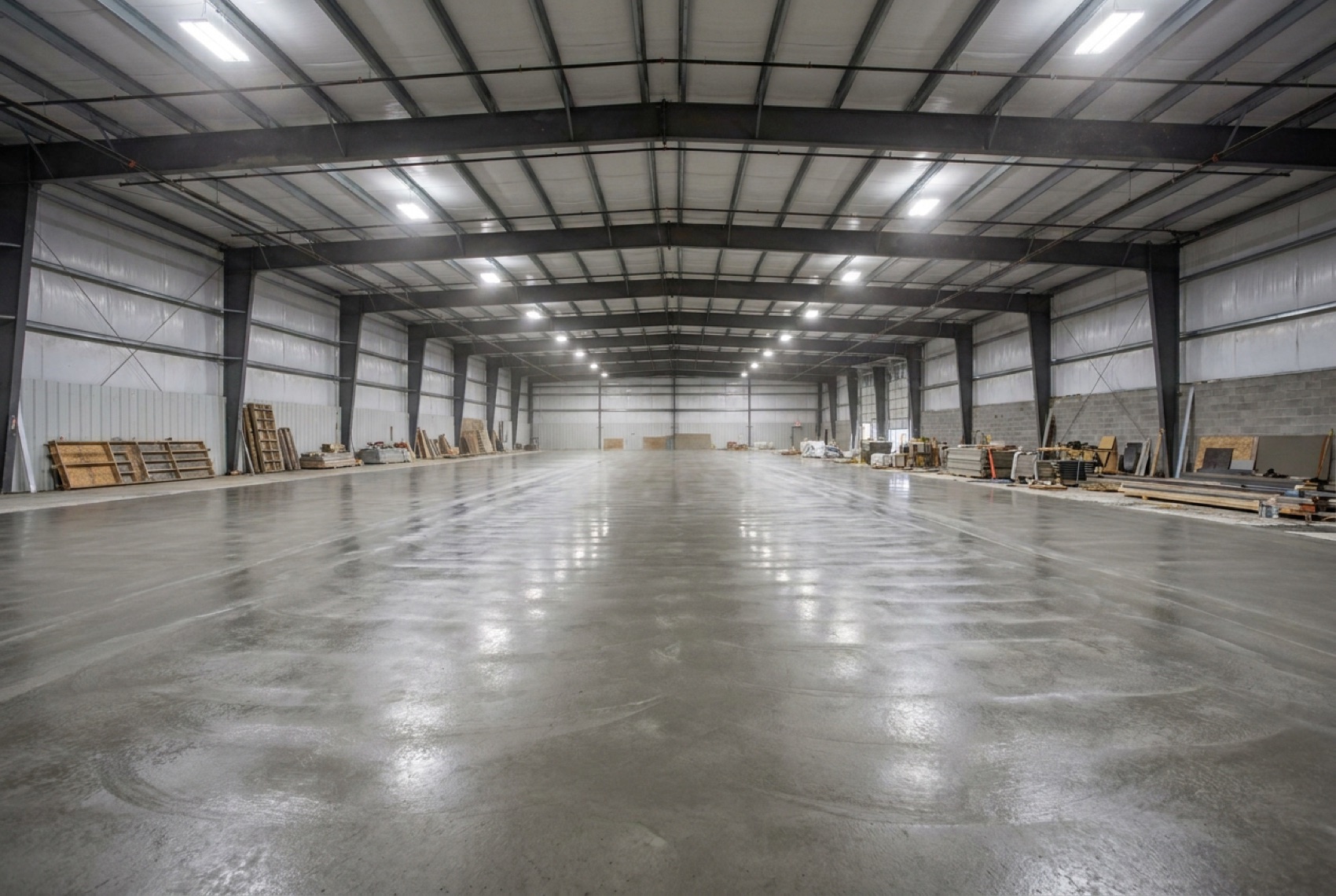
Garage slabs, shop floors and building slabs
Garage and shop slabs get parked on, dropped on and rolled on. We pour them flat, at the thickness the use calls for, with reinforcement in the slab and a hard finish that takes a jack stand without chipping up. If you want a floor drain, a thickened edge under a lift, or an apron out to the drive, say so at the estimate and we form it in from the start.
Pole barns, additions and outbuildings work the same way. We set the slab to your building footprint, hold the elevations your builder hands us, and leave a surface that is ready for whatever goes on top of it.
Foundations, footers and poured walls
Footers carry the whole building, so they get poured to the size and depth the plan and the ground call for. Red clay holds water, and that matters when you are digging and pouring here, so we watch the trench and pour on a base we trust.
We form and pour walls for basements, crawl spaces, garages and retaining. A poured wall goes up as one solid piece, so there are no block joints to chase later. We set the forms plumb, brace them properly, and place the steel before anything gets poured.
Foundation work is the part of a house nobody sees once the framing goes on. That is exactly why we do not rush it, and why we spec strength to the load: commonly a 4,000 PSI air-entrained mix built for Virginia freeze-thaw.
Stamped and decorative concrete
Stamped concrete gets you the look of stone, brick or plank on a slab that pours and cures like any other slab. We stamp patios, walkways, porches and pool decks, and color can go in the mix, on the surface, or both.
Decorative does not only mean stamped. A broom finish with a saw-cut pattern, exposed aggregate, a banded border, or a colored joint layout all change how a slab looks without changing how it performs. We will walk you through the patterns and colors that hold up outdoors through a mountain winter, and pour what you pick.
Commercial flatwork, sidewalks and steps
We pour commercial flatwork for builders, property owners and general contractors: building slabs, equipment pads, aprons, loading areas and walks. We work off the prints, hold the schedule, and bring our own pump when the pour needs one instead of waiting on somebody else's.
Sidewalks and steps are their own kind of work. Steps have to be right or people feel it underfoot: consistent rise, level treads, solid footing under them. We form them, pour them and finish them so they wear the way they should. Public-facing walks get the same attention, because a rough joint or a bad slope shows up the first time it rains.
Concrete pumping with our own line pump
We own a trailer-mounted line pump and run it with our own operator and a hose guy. It pushes through 2.5 inch and 3 inch line, which covers everything from a footing to a big flatwork pour.
The advantage of line is access. We snake hose through a gate, down a side yard, around the back of the house or into a basement, which is how backyard slabs and basement floors get poured when the ready-mix truck cannot get anywhere near the forms. The big rigs other outfits bring have their place on tall or wide open work. On most residential pours around here, hose on the ground is what actually reaches, and it reaches without tearing up your yard to make room.
Most crews rent a pump when they need one. We own ours, so on our own jobs the pumping is built into one price instead of landing on your quote as a separate line. We also sub the pumping to other contractors: our pump, our operator, on your pour, with your crew placing and finishing.
A pump usually makes sense when the pour is a foundation, when it runs roughly eight cubic yards or more, or when the truck simply cannot get close enough to chute it.
Every job starts with a free written estimate
All of it starts the same way. You call, we come out, we measure, and we talk through the options that actually apply to your lot instead of a generic package. Then you get a clear written quote, usually within a day or two.
Rough numbers over the phone are fine if you just want a ballpark, but we measure on site before anything is final. The written estimate spells out the scope, the thickness, the finish, and whether the pour needs the pump. Our workmanship warranty is in writing as well, with the exact terms confirmed on your written estimate.
We work anywhere within about an hour to an hour and a half of Hillsville: Carroll, Grayson, Wythe, Pulaski, Montgomery and Floyd counties, up the I-77 and I-81 corridors into the New River and Roanoke valleys, and across the North Carolina line into Mount Airy and Surry County. Not sure if you are in range? Call and we will confirm your address.