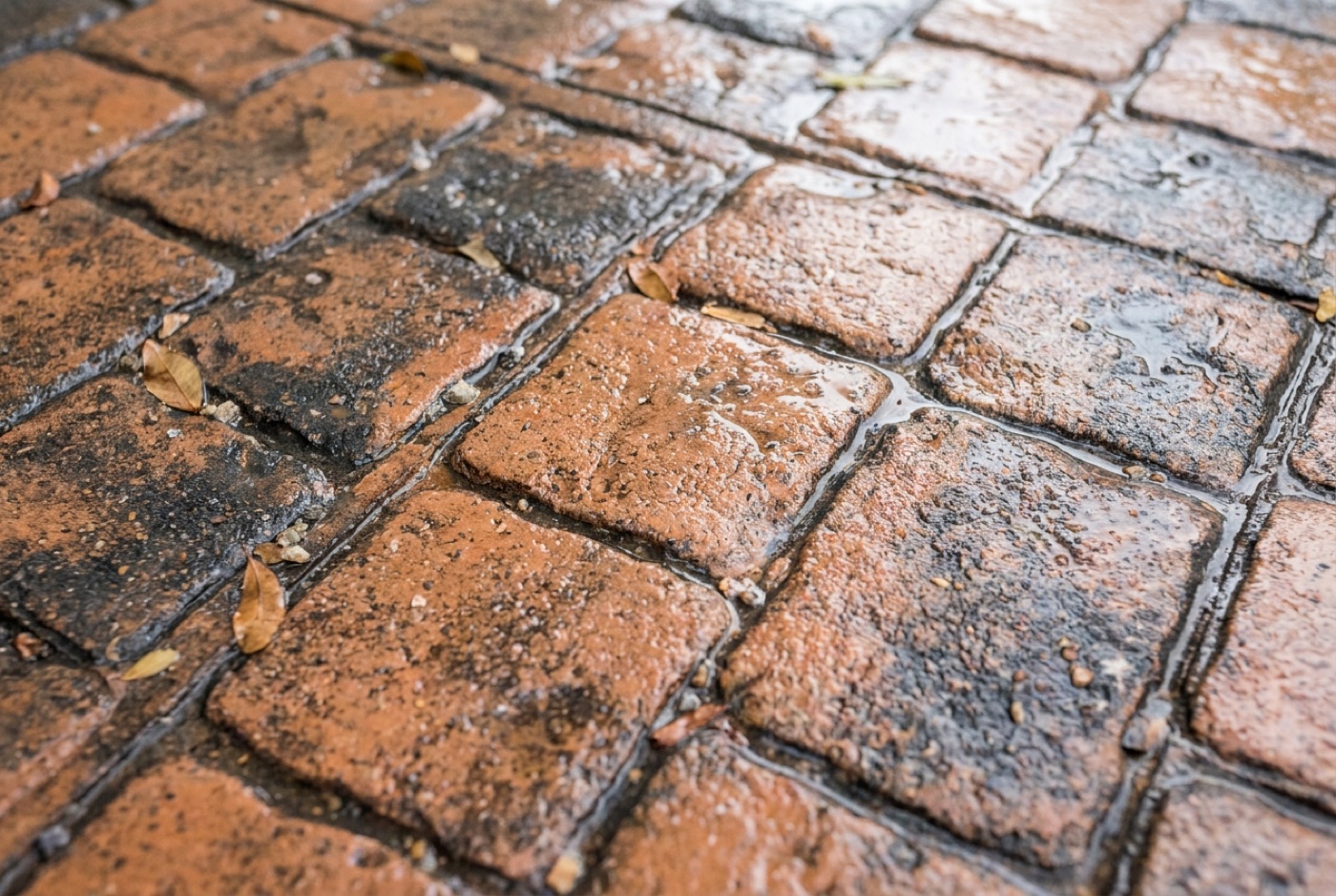
What stamping actually is
Stamped concrete is an ordinary slab with two extra operations done while the concrete is still soft. Color goes in. A pattern gets pressed into the surface. Everything underneath, the compacted stone, the reinforcement and the mix, is the same work that goes under a plain slab.
Color arrives one of two ways. Integral color is batched into the ready-mix, so pigment runs the full depth and a chipped edge does not flash gray. Broadcast color is a hardener cast onto the floated surface, leaving a denser top layer where the wear happens.
Release agent comes next, keeping the mats from grabbing the fresh surface. Powder release also settles into the low points of the print and stays there after the wash down, leaving a darker tone inside the grout lines. That contrast is what makes a slab read as stone.
Mats go down in sequence and get tamped so the print seats to full depth. Edges and corners where a rigid mat cannot lie flat get hand worked with a flexible skin and a chisel. The concrete has to be stiff enough to hold a print and soft enough to take one.
The pattern families, in plain language
There are hundreds of stamp patterns and the names mean nothing until you see them, but they fall into a few families. Scale matters more than people expect. A large stone pattern on a small entry landing looks like one and a half stones and nothing else, so we size the pattern to the slab and give the field a border to stop against.
- Stone. Irregular edges, no repeating grid. Casual, and hides dirt and traffic best.
- Slate. Flat panels with a fine texture, often in a running or ashlar layout. Safe next to any house.
- Wood plank. Long boards with grain pressed in. A deck look that will not rot or need staining.
- Brick. Running bond or herringbone in a clay tone. Ties in with brick on the house.
- Seamless. No pattern lines, just stone texture. Quieter, and the most forgiving on odd shapes.
Color, and how it weathers
Concrete is not paint and never behaves like paint. Every batch of ready-mix has its own personality, and pour day weather changes how the color pulls. We will not promise a match to a sample chip, to a photo, or to concrete somebody else poured on your property years ago. Anyone who does is telling you what you want to hear.
What we will do is show you the color families, set pattern and tone together before we form anything, and be straight about the range you are likely to land in. Next to existing stamped work, the honest play is a border or a separate field. Where an owners association reviews finishes, bring HOA approval of concrete work into that same conversation.
Color also moves as a slab ages. Ultraviolet light pulls pigment down a shade, most of that inside the first two seasons. Traffic burnishes the high points while the low points hold their darker tone, which reads as depth rather than damage. Efflorescence, a chalky salt bloom working out of the concrete, can show on a young slab and then wash off. None of that is failure. What costs you the look is a bare surface.
Sealing is real maintenance, not a sales line
People usually learn this part after the fact, so we say it at the estimate. Stamped concrete needs sealer, and sealer is a consumable. It wears off. Figure roughly two to three years between coats, quicker in open sun, quicker under trees that drop sap and tannin.
What the sealer buys you is a replaceable wear layer between traffic and the colored top of the slab, plus color that holds and pores that shed grease and leaf stain. Let it go long enough and the fix stops being a recoat and turns into stripping and rebuilding the surface.
A recoat is also more than rolling fresh product over what is there. The slab gets cleaned, and it has to be dry the whole way through, because sealing moisture into a surface causes the milky blush people blame on the product. Two thin coats outlast one heavy one, and a heavy one peels in sheets a few winters later.
Traction is the honest tradeoff with any film on concrete. High gloss over a shallow print gets slick once water is on it, which matters on a pool deck or a walk that stays wet. We work an anti skid grit into the topcoat and lean toward prints with real depth.
Stamped or a plain broom finish
Short version. A broom finish costs less, grips well wet, and asks almost nothing of you after the pour, while stamped costs more and trades some of that ease for the look. The full comparison, with the price bands set beside each other, is on our patios page.
The way to decide it is not the number on the estimate, it is what the slab asks of you afterward. A broom finish is a one time cost. You pour it, you keep the de-icing salt off it the first winter, and after that it mostly looks after itself. Stamped concrete is the up front cost plus a recurring one, because the sealer that carries the color is the part that wears, and it comes back around every few years for as long as you own the slab.
So the honest question at the estimate is not whether you like the look. Almost everybody likes the look. It is whether resealing is a job you will actually keep up with, or one that will quietly stop happening by year four and leave you with a faded patio you paid a premium for.
The rule we hold to at the estimate is simple. If nobody is going to keep sealer on the slab, broom finish or exposed aggregate is the better buy, and we will say so.
Where stamped is the wrong call
Heavy vehicle traffic is the first one. Stamped color lives in the top layer, and truck tires scuffing and turning wear that layer through where they work hardest. Where a dump truck, an RV or a loaded trailer sits, a broom finish is the smarter surface.
Hard salting is the second, and snow tools go with it. Deicing salts attack any concrete, and on stamped work they attack the layer carrying the color. A steel shovel edge or a plow blade set to scrape catches the high points of a deep print. Sand and a poly shovel are kinder.
Third is ground nobody dealt with. A pattern pressed into a slab sitting on soft fill or uncompacted clay is just a nicer looking slab going to move. Base prep, drainage and joint layout come first here exactly like anywhere else.
What stamped concrete costs
Stamped and decorative work is $14 to $22 per square foot installed. Where your job lands comes down to hand forming, how many colors and patterns are in play, border work, tear out, and how a ready-mix truck reaches the pour. Tear out and haul off adds $2 to $3 per square foot. Rebar or mesh adds $0.75 to $1.25.
The volume math behind those numbers, cubic yards plus 10 percent for waste and a load count at 10 cubic yards a truck, is laid out on our page about what drives concrete prices and run out step by step on our stamped concrete cost page.
These are installed ranges, not a quote. We measure on site, look at the access, the grade and the base, and put a free written estimate in your hands. The workmanship warranty is in writing too, with exact terms confirmed on that estimate.
How a stamped pour goes on your property
The groundwork is no different from a plain slab, and the full sequence has its own page on how a job goes. Sod off, grade cut so water leaves the house, stone base compacted, forms set, reinforcement on chairs. None of that is stamping, and all of it decides how the stamping holds up.
Pour day runs long and everybody is on it. Concrete goes in, gets screeded and floated, color goes on, and the mats move across the slab while it is at the right stage. From placement forward, the clock belongs to the concrete.
Access is what stalls backyard and pool deck jobs. A loaded ready-mix truck does not fit through a gate and will not cross a finished lawn without leaving ruts. That is why we own a trailer mounted line pump. Our operator runs the machine, our hose guy works the end of the line, and the concrete keeps coming at one even pace, so no part of the slab gets ahead of the rest. Most crews book one from somebody else and take the slot they are handed. Ours has its own page.
Then it is cure time. Foot traffic is usually fine in 24 to 48 hours, full strength comes around 28 days, and sealer waits until the slab has cured.