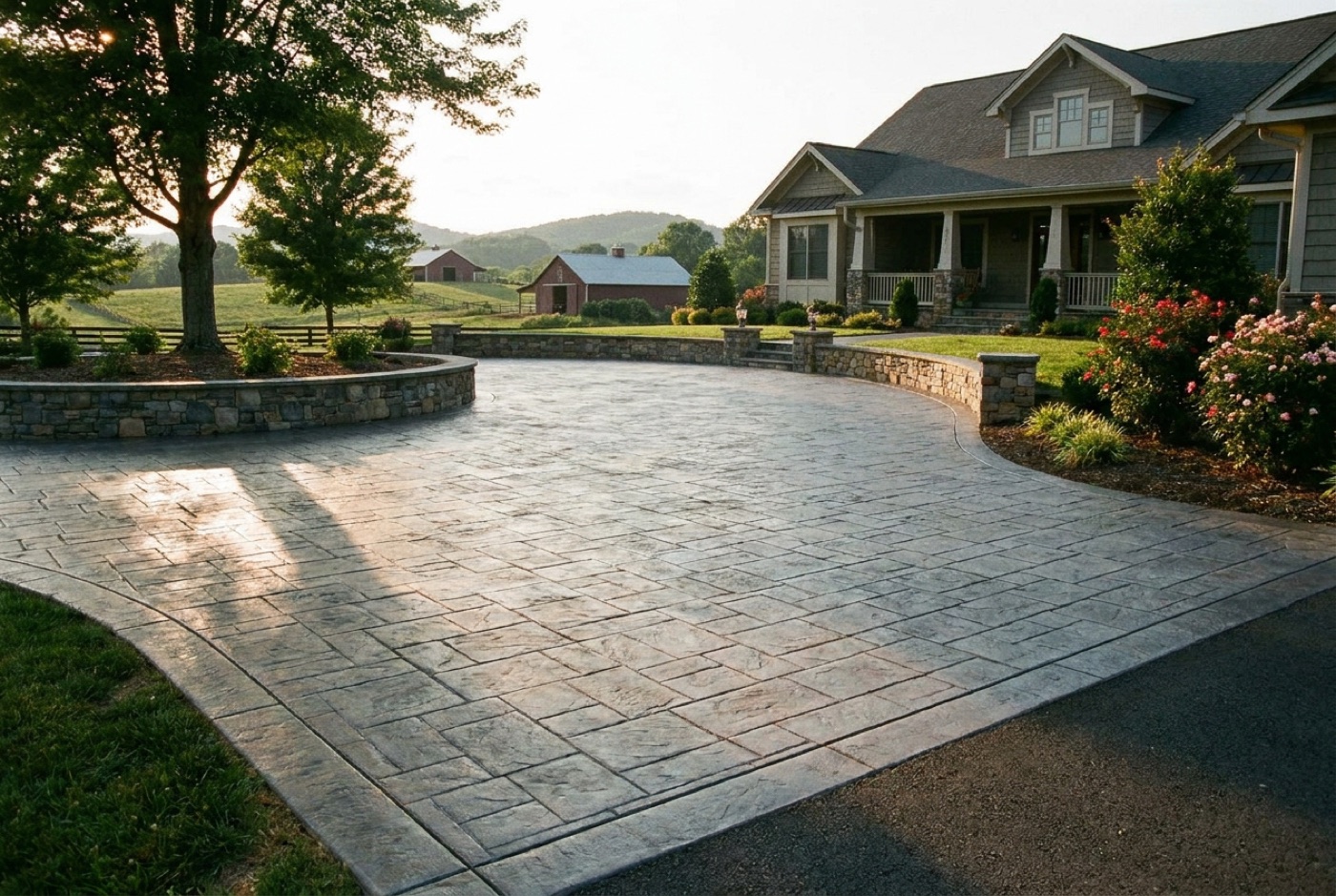
What $14 to $22 installed covers
Stamped and decorative work in our counties prices at $14 to $22 per square foot installed, poured at 4 inches like any other patio. Treat it as a planning band. It becomes one figure only once the slab is measured and the pattern and color are settled.
Installed means the finished slab, not concrete off a truck, and our cost guide lists what sits inside that word. The workmanship warranty is in writing, with exact terms confirmed on your written estimate.
Four steps to your own stamped figure
None of this needs us. A tape gets you the area and a phone does the rest. The last two steps need one fact. Ready mix arrives 10 cubic yards at a time, and you order about 10 percent over the calculated volume for waste.
- Area. Length times width in feet. Anything that is not a rectangle gets broken into rectangles first.
- Dollars. That area times 14 for the low end of the band, times 22 for the high end.
- Volume. At 4 inches a square foot of slab is a third of a cubic foot, so the area divided by three gives cubic feet.
- Yards and loads. Cubic feet over 27 gives cubic yards. Add 10 percent. Divide by 10 and round up for the load count.
The 10 by 12, stamped edge to edge
10 by 12 is 120 square feet, the size most people mean when they say a patio off the back door. Our patio cost page runs it broom finished. Here it is run stamped, at the band that finish carries.
Money: 120 square feet times 14 is $1,680, and times 22 is $2,640. Material: 120 square feet at 4 inches is 40 cubic feet, which over 27 is 1.48 cubic yards, and 1.63 once the waste allowance goes on. That sits well inside a single load.
A 16 by 20 with a dining end and a sitting end
16 by 20 is 320 square feet. That is where a patio stops being one zone and becomes two, a table at one end, chairs or a grill at the other.
Money: 320 square feet times 14 is $4,480, times 22 is $7,040. Material: 320 square feet at 4 inches is 106.7 cubic feet, which over 27 is 3.95 cubic yards, and 4.35 with waste. One load again.
The 16 by 20 is more than two and a half times the area of the 10 by 12, and both still order out of one delivery. Whatever separates these two jobs on paper, it is not the truck count.
The concrete order does not know what finish is going on top
Volume comes off area and thickness and nothing else. A 120 square foot slab is 40 cubic feet whether it gets broomed or stamped, and the 16 by 20 is 106.7 cubic feet either way. The finish decides which band multiplies your square footage. It does not move a yard of what gets batched.
Neither patio reaches the pump on volume, either. The trigger is a foundation, roughly eight or more cubic yards, or a lot too tight for a chute, and at 1.63 and 4.35 yards these two are not close. Access is what brings the hose out at this size, and on our own pours that placement is already inside the band above.
Both ends of $14 to $22 are real prices
Look at what $14 to $22 does to one number. On the 16 by 20 it is the gap between $4,480 and $7,040 for the same 320 square feet of slab, and neither end is a scare figure. So the useful question is not what stamped concrete costs. It is which end your patio sits at, and our stamped and decorative page walks through what moves a job inside the band. Until somebody has measured, plan against both ends and treat the top as real.
Stamping part of a patio and brooming the rest
Every area gets figured on its own band, which our cost guide sets out as a rule. Here it is, run out on the two sizes above.
Say the 16 by 20 gets a stamped field, 10 by 12 of it, and the rest is broom finished. The stamped 120 square feet is figured at $14 to $22, so $1,680 to $2,640, on its own line. The other 200 square feet is broom finished patio work, figured on the patio band our patio cost page carries, on a line of its own.
There is no blended rate across all 320 square feet, because a blended number hides how much of the patio is actually being stamped.
The mistake people make with the two numbers
The common error is arithmetic. Somebody takes a stamped figure and a broom finished figure for the same patio and subtracts one from the other. What is left is the gap between two different jobs at two different bands, and our page on what drives concrete prices explains why they are two jobs. On this page the only point is arithmetic: your square footage gets multiplied by one band or the other, and no square foot carries both.
The other half of it is timing. Color and pattern go into the slab while the concrete is still soft, inside a window that closes on pour day. Nobody is coming back next spring to press a pattern into the 120 square feet you already poured. Stamping a cured slab means an overlay, a different job described on our overlay glossary page, not the slab you are pricing here. The decision belongs at the estimate, before a form goes in the ground.