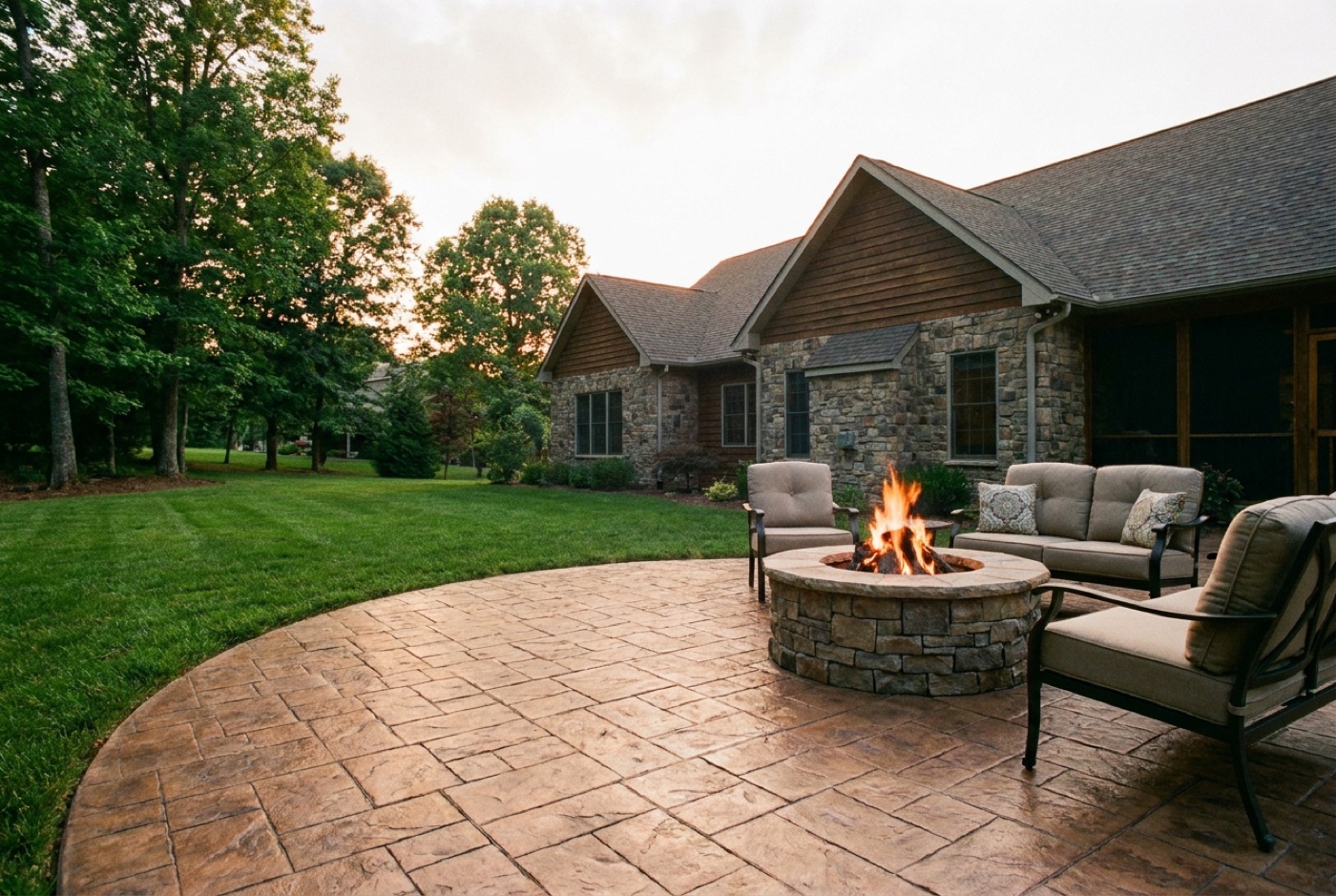
Why patios price above driveways
Around Hillsville and the counties we reach from the shop, a broom finished patio or walkway poured at 4 inches sits in the $9 to $14 band. Plan against it. The figure you sign is free and in writing, and it comes after somebody has stood in the yard.
That band sits a dollar or two above the driveway band, for reasons specific to patios rather than to concrete. What the word installed covers is the same on every band, and our cost guide lists it line by line.
- Edge. A driveway is a long rectangle. Patios wrap corners, notch around a tree and curve where a rectangle would look wrong, and all of that gets formed by hand.
- Where it sits. The patio is behind the house, past a gate, a septic field or a lawn nobody wants ruts in. How the concrete reaches the forms is part of the price here in a way it rarely is on a drive.
- What it touches. A drive meets the road and the garage. A patio meets a stoop, a threshold, an old slab, a deck footing, and each one is a joint somebody has to get right.
- What goes on top. A driveway is broomed and that is the end of it. On a patio the finish is the one choice that can move you out of this band entirely.
The arithmetic, four steps
Anybody with a tape and a phone calculator can get inside a planning range before making a call. Here is the whole of it.
Two notes before you trust the last two steps. Ready mix comes 10 cubic yards to a truck and a partial load is billed as a whole one, so yardage climbs in steps instead of a smooth line. And the 10 percent is not padding. Forms flex, no subgrade is truly flat, and some concrete stays in the chute on every pour. The estimator applies both, then rounds its display in $50 steps, so it can sit either side of the multiplication below.
- Area. Length times width in feet. A patio 10 by 12 is 120 square feet. Anything that is not a rectangle gets broken into rectangles first.
- Range. That area times 9 for the low end of the band, times 14 for the high end.
- Volume. Thickness in feet times area gives you cubic feet, and 4 inches is one third. Divide by 27 to reach cubic yards, then add 10 percent.
- Trucks. Yardage over 10, rounded up to the next whole load.
A 10 by 12 off the back door
Start with the small one. A slab off the back door holding a table, two or three chairs and room to walk past them. 10 by 12 is 120 square feet.
Dollars first. At the low end of the band, 120 square feet is $1,080, and $1,680 at the high end. Concrete next. Thickness in feet is a third at 4 inches, so 120 square feet works out to 40 cubic feet. Run 27 into that and you have 1.48 cubic yards, or 1.6 once the waste allowance goes on. Nowhere near a full load.
This is also the size where the edge argument shows itself in numbers. That patio carries 44 feet of form around 120 square feet of slab, better than a third of a foot of edge for every square foot poured. A 24 by 30 patio carries 108 feet of form around 720 square feet, about a seventh. Same crew, same forms, same delivery, spread across six times the area. Small patios sit high in the band and no trick moves them down.
A wraparound, and the 12 feet of edge it adds
Now the shape people ask for when two doors open onto the same idea. Say the slab runs 26 feet along the back of the house and 20 feet out at its deepest, with a 12 by 10 corner left in lawn around a tree. The bounding rectangle is 520 square feet, less 120 in that notch, so the patio is 400 square feet. The range is $3,600 to $5,600 installed, and the concrete works out to 133.3 cubic feet, 4.94 cubic yards, 5.4 with waste. One load with room left in it.
Here is the part a rectangular drive never shows you. Taking that corner out removed 120 square feet of slab and did not remove a single foot of form. The perimeter is still 92 feet, what the full 26 by 20 would have been, while a plain 20 by 20 patio is the same 400 square feet on 80 feet of edge. Same concrete, 12 more feet of form, plus an inside corner laid out square, formed on two faces and finished by hand. Identical square footage, higher in the band.
Add-ons ride on the footage rather than the shape. A tied rebar grid in place of wire mesh runs $0.75 to $1.25 on top of the band, so $300 to $500 across 400 square feet. If an old cracked slab has to come out first, that is $2 to $3 on the same footage, or $800 to $1,200. Both show as their own lines.
720 square feet around a fire pit, and where the second load starts
The outdoor living version. A 20 by 24 main slab, 480 square feet, with a bay off one corner for a fire pit and the chairs around it, 12 by 20, another 240. Call it 720 square feet, measuring the curved bay as the rectangle it occupies. The range is $6,480 to $10,080 installed. The concrete is 240 cubic feet, which is 8.89 cubic yards, and 9.8 with waste. One load, with very little left in it.
Now add the walk out to the driveway, 4 feet wide and 30 feet long. That is another 120 square feet at $1,080 to $1,680. Together the job is 840 square feet, $7,560 to $11,760, and 280 cubic feet of concrete, which is 10.37 cubic yards and 11.4 with waste. Two loads. The walk did not just cost its own square footage. It ordered a truck.
A pour this size is also over the line where the pump comes out. A foundation, roughly eight or more cubic yards, or a lot too tight for a chute, and the concrete goes on hose. We run a trailer-mounted line pump with an operator and a hose guy, on 2.5 inch and 3 inch line, so the hose goes through the gate and the truck never has to leave the driveway. That matters more on a patio than anything else we pour, because the patio is the one slab nearly always behind the house. Most crews rent a pump and bill it separately. We own ours, so placement is inside the installed price.
Everything the patio has to touch
A driveway meets the road at one end and the garage at the other, and that is the whole of its relationship with anything. A patio is surrounded by things it has to get along with: a stoop at the back door, an old slab, a deck footing, a sunroom wall. Each one is a joint to plan and an elevation to get right the first time, because the second time means saw cutting finished concrete.
None of that is billed as an extra. It is labor inside the band, and it is a large part of why two patios of the same square footage come back with different figures. A rectangle sitting free in the yard is the low end of the band. A slab threading between a stoop, a walk that has to stay put and a tight door threshold is the high end.
The finish is the one upgrade decision a driveway never asks you
A drive gets a broom finish and there is not much to argue about, because the surface has to grip in ice and live under a plow blade. A patio is the one piece of flatwork where the finish is genuinely open, and it is the fastest way to move your own number.
Broom sits inside the $9 to $14 band on every size above. Exposed aggregate costs more in labor and in timing, because the surface gets washed at the right moment and that moment does not wait. Stamped and decorative work is not the same slab with a fee stuck on it. It carries its own band, $14 to $22 installed.
Notice that the two bands touch at $14, so a plain patio at the top of its range and a simple stamped patio at the bottom of its own are closer together than people assume. On the 400 square foot wraparound that is $5,600 broom finished at the top against $5,600 stamped at the bottom, running to $8,800 for the elaborate version. What the extra labor buys is on our stamped and decorative page. If you want that comparison run as arithmetic instead of as a range, the 10 by 12 above is carried out again at the stamped band.
What the tape measure sees and the calculator does not
Everything on this page is arithmetic against a range, which is enough to budget from. What it cannot do is look at the ground the slab is going on: a back yard that falls away hard enough to want a step down instead of one flat plane, red clay subgrade holding water all winter, no mixer truck getting near the forms. The page we keep on what drives concrete prices takes those variables across every job type.
So we come out. We measure the space, walk the fall, see where the runoff ends up, settle what the slab is tying into, and work out how the concrete reaches the forms. What comes back is one page carrying your address, the scope, the thickness, the base, the steel, and one figure at the bottom. No charge for the visit or the page.
The workmanship warranty is on that same page, with exact terms confirmed in writing on your estimate. Call 276-733-3750, or email [email protected]. Somebody is there weekdays, 7:30 to 4:30.