Why your quote does not match the number you found online
National averages are averages. They price the easy version of the job on easy ground, not a slab going down on red clay on a Blue Ridge hillside. Our installed ranges for southwest Virginia are below, the same bands the estimator on our homepage runs.
Those are ranges, not numbers. The spread inside a band is the sum of the decisions below. Two driveways the same size on the same road can land at opposite ends of it.
- Driveway, 4 inches standard: $8 to $12 per square foot
- Patio or walkway: $9 to $14 per square foot
- Garage slab at 5 inches: $8 to $12 per square foot
- Sidewalk: $10 to $15 per square foot
- Foundation at 8 inches: $14 to $22 per square foot
- Stamped or decorative: $14 to $22 per square foot
- Rebar instead of wire mesh: adds $0.75 to $1.25 per square foot
- Tear out and haul off old slab: adds $2 to $3 per square foot
Thickness, and why it moves two things at once
Four inches is standard flatwork. A garage floor goes to 5 inches, which is why it carries its own band at $8 to $12 per square foot. Foundations go to 8 inches. Stepping from 4 inches to 5 is 25 percent more concrete, and 4 to 6 is 50 percent more, straight material before any extra labor.
Usually thickness moves you up inside the band you are already in. A driveway thickened at the road apron is still a driveway in the $8 to $12 range, just nearer the top. It changes the band only when it changes what the job is. A foundation at 8 inches runs $14 to $22 per square foot, and that is not simply twice the concrete. It gets dug instead of graded, it carries steel, and it usually needs the pump.
Do not let anybody talk you thinner to win a bid. Four inches under a dump truck is a slab with a crack already in its future.
Reinforcement, wire mesh against a tied rebar grid
Wire mesh works, as long as it gets pulled up into the slab while the concrete goes in. Mesh left lying flat on the stone does nothing. Where the steel sits matters as much as whether it is there.
A tied rebar grid adds $0.75 to $1.25 per square foot. It buys strength across soft spots in the subgrade and holds the two sides of a crack together if one opens, so the slab stays one piece. It earns its keep on long drives, on fill, on slopes, and anywhere heavy vehicles park. It is also the easiest line on a bid to quietly delete, because once the concrete is placed nobody can see it.
The ground work: tear out, excavation and the sub base
If there is already concrete or asphalt where the new pour goes, it comes out first. Breaking it up, loading it and hauling it off adds $2 to $3 per square foot on top of the new pour, and it shows as its own line. Then the dirt: cutting grade so water sheds away from the house, stripping soft topsoil, hauling spoil off. How much dirt moves is one of the largest swings on any job, and none of it reads off a photo.
The sub base is the cost you cannot see and the one that decides whether the slab is still flat in ten years. The native ground here is red clay. Clay holds water, swells when it freezes and shrinks when it dries, so a slab poured straight on it sits on something that moves all winter. Crushed stone, compacted in lifts, gives the concrete a base that drains.
That is the step failures skip. A slab that cracked and settled in three winters almost never failed on the concrete. It failed because there was not enough stone under it, or nobody compacted it.
Access, and how the concrete gets to the forms
Concrete has to travel from the chute to the forms, and how it travels is a real line item. If the mixer truck backs straight up to the forms, that job sits near the bottom of its band.
Plenty of jobs are not that. A patio behind a fence. A basement slab. A footing at the bottom of a bank. A finished lawn or a septic field you would rather not have ten wheels driving across. Then the concrete gets wheelbarrowed, or it gets pumped.
We run our own line pump, 2.5 inch and 3 inch line, with an operator and a hose guy. The hose goes around the house, over a fence, and into a backyard you cannot back a truck into. Most crews rent a pump when a job calls for one, and it lands on the bill as a separate line with a markup. Because we own ours, placement is built into the one price on our own pours.
Finish, and the one that moves you into another band
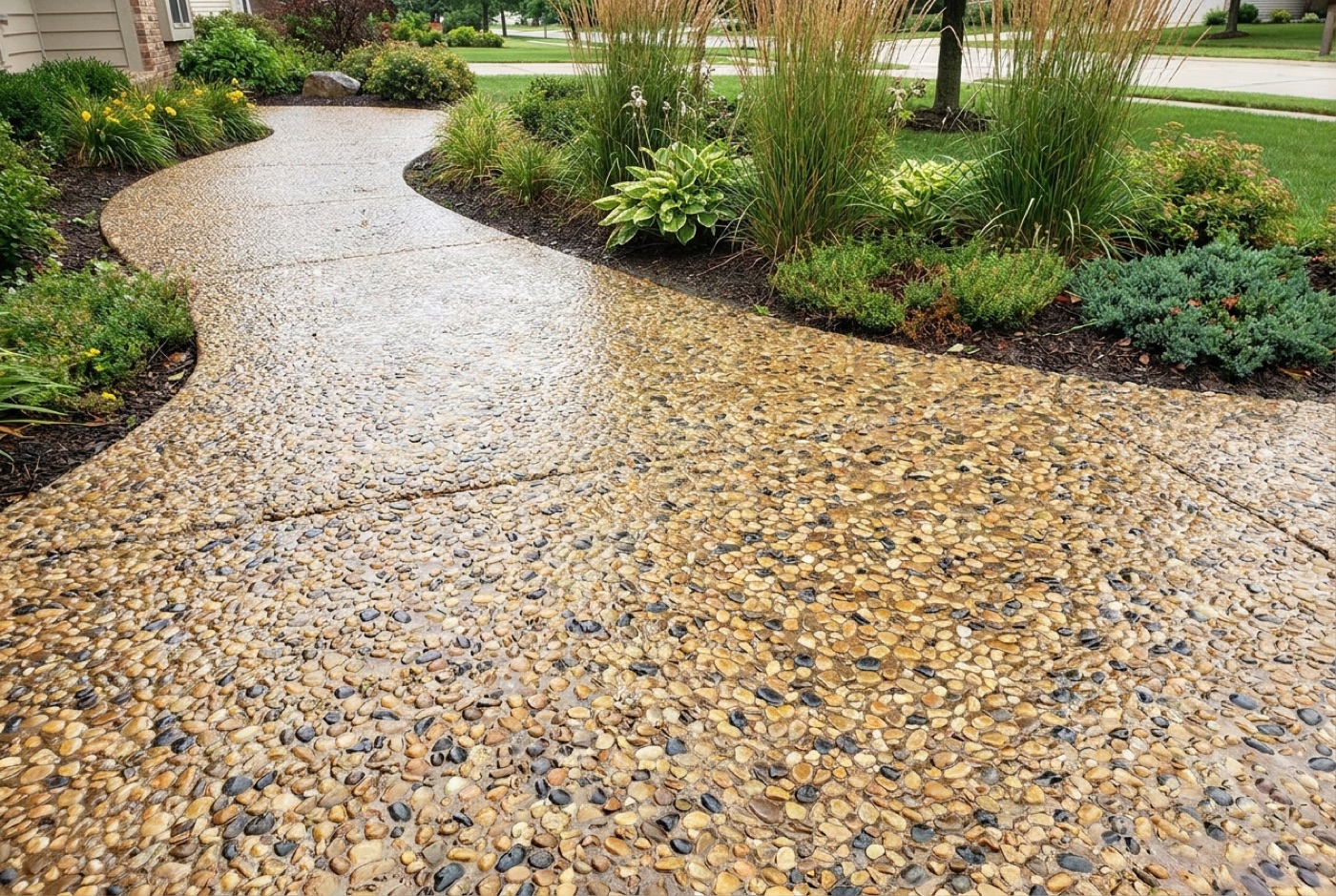
A broom finish is the standard on drives, walks and pads. Dragged across the fresh surface, it gives traction in rain and snow and sits inside the base band. A hard trowel finish is smooth, belongs indoors on garage and shop floors, and is slick outside as soon as it is wet. Exposed aggregate, where the surface paste is washed back to show the stone, costs more in labor and timing, because the wash window is short.
Stamped and decorative work moves you into a new band entirely, $14 to $22 per square foot, and what that band comes to on two patio sizes is multiplied out in full. That is not a markup on the same slab. Stamping means color, release agent, mats pressed by hand while the concrete sits in a window that will not wait, joint work and sealing. A lot more labor in the same couple of hours.
Season, weather and how ready mix gets ordered
Concrete does not care about your calendar, it cares about temperature. A cold weather pour needs thawed ground, an adjusted mix, and blankets over the fresh slab so it holds its own heat while it sets. That is material and labor a June pour never needs. Hot, dry and windy is the other end, because water leaves the surface faster than it rises, and shrinkage cracking starts there.
Freeze thaw is not theoretical at this elevation. Water works into the surface, freezes overnight and pries the concrete apart a little at a time. That is why we spec an air entrained mix, commonly 4,000 PSI.
Then delivery. Ready mix is ordered in 10 cubic yard loads and a job rounds up to the next full load, and you add 10 percent for waste on top of the calculated volume, because forms flex and some always stays in the chute. That is why a small job costs more per square foot than a large one, and why a short walk can carry a load minimum. There is a $50 floor on the estimator.
Why the cheapest bid is usually the one that cut something
When three bids come in and one sits well under the other two, it is almost never because that crew found cheaper concrete. Ready mix costs what it costs. The savings came out of the parts nobody can inspect afterward.
It is usually one of two things. The slab is thinner than what was called out, three and a half inches sold as four. Or the stone base is thin or skipped and the concrete went down on graded clay. Both save real money on bid day. Both come back as cracks inside a few winters, and by then that crew is not answering.
So compare the same items on each page. Thickness in inches. What reinforcement, and how it is held up in the slab. How much stone, and compacted in lifts. Joint spacing. How the concrete reaches the forms. If a bid does not say, ask. Ours says, and the workmanship warranty is on that same page, with terms confirmed in writing on your estimate.