The short answer
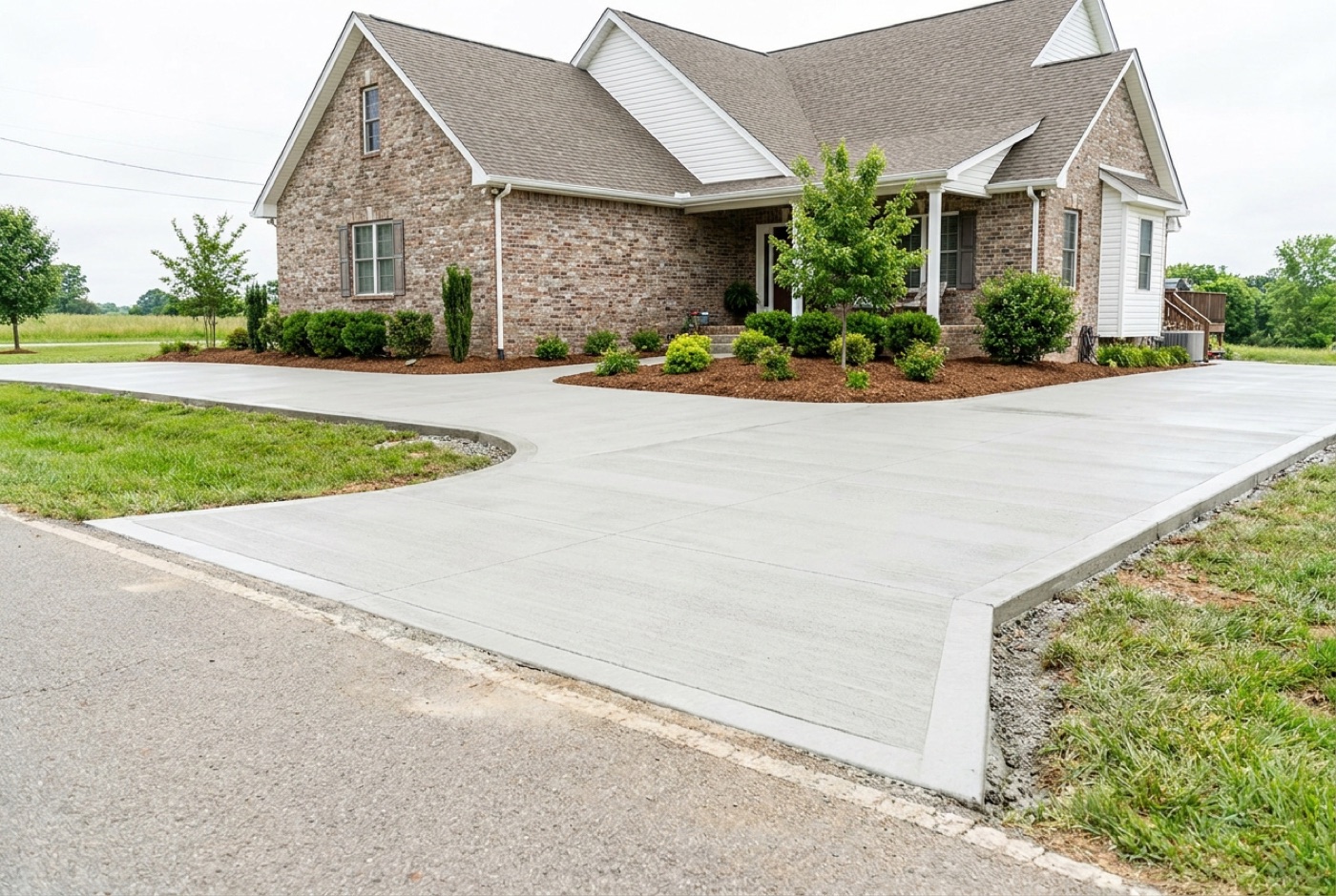
Concrete driveways in Carroll County and the counties around it run $8 to $12 per square foot installed at our standard 4 inch thickness. That is a planning range, not a number on paper. The number on paper comes free and in writing after we measure your site.
Installed means the whole job. Excavation, stripping sod and soft topsoil, cutting the grade so water sheds away from the house, a compacted stone base, forms, wire mesh or rebar, the ready mix, the broom finish, control joints, and hauling our mess off your property.
Where a job lands inside that range is not random. A flat, open rectangle with easy truck access, wire mesh and a broom finish sits near the bottom. A drive with an old slab to break out, a slope that needs fill, a tied rebar grid, curves and turnarounds, or access that keeps the mixer truck out at the road sits near the top.
Work your own number in about a minute
You do not need us to get in the ballpark. Four steps and a calculator, and it is the same math the estimator on our homepage runs.
One note on the last two steps. Ready mix is ordered in 10 cubic yard loads, so yardage does not scale smoothly, it steps. Crossing from 9.9 yards to 10.9 means a second load, and you pay for concrete that is ordered, not concrete that is placed. That is why the 10 percent waste allowance sits in the math and not in a surprise later.
One more note if you check your arithmetic against the estimator on our homepage. It works in $50 steps, so the figure it returns can land a few dollars either side of the straight multiplication we run below. Same math, rounded for reading.
- Square footage. Measure length and width in feet and multiply. A drive 12 feet wide and 40 long is 480 square feet.
- Dollars. Multiply square footage by 8 for the low end and by 12 for the high end.
- Cubic yards. Convert thickness to feet, 4 inches is one third of a foot, then multiply by square footage for cubic feet. Divide by 27, then add 10 percent for waste.
- Loads. Divide your yardage by 10 and round up.
A single car drive, 12 by 40
Start with the most common job we price around Hillsville: a straight single lane from the road to the house, 12 feet by 40 feet. Twelve times forty is 480 square feet.
Dollars first. 480 square feet at the bottom of the range is $3,840. At the top it is $5,760. So the planning range on that drive is $3,840 to $5,760 installed.
Now the concrete. At 4 inches, which is one third of a foot, 480 square feet is 160 cubic feet. Divide 160 by 27 and you get 5.9 cubic yards. Add 10 percent for waste and you are at 6.5 cubic yards. That fits a single 10 cubic yard load, which is the cheapest place a pour can sit.
Worth knowing before you measure: shape does not change the square footage math. A 20 by 24 parking pad is also 480 square feet, and it prices out to the same $3,840 to $5,760 on the same 6.5 cubic yards and the same load. What shape changes is form work. A long skinny drive has more linear feet of form and more edge to finish than a square pad of the same area.
A two car drive with a turnaround, 20 by 40
Widen that same 40 foot run to 20 feet so two vehicles sit side by side and you can turn around without backing into the road. Twenty times forty is 800 square feet, and the planning range is $6,400 to $9,600 installed.
The yardage is where this one gets interesting. 800 square feet at 4 inches is 266.7 cubic feet. Divided by 27 that is 9.9 cubic yards. Add the waste allowance and you land at 10.9 cubic yards, which pushes the job into a second ready mix load. That step from one load to two is real money, and it is worth knowing before you decide to add three more feet of width.
Thickness works the same way. Pour that area at 5 inches instead of 4 for a loaded trailer or an RV and the same 800 square feet becomes 333.3 cubic feet, or 12.3 cubic yards, and 13.6 with waste. Still two loads, but more concrete inside them. Thickness does not create a new price band. It moves you up inside the $8 to $12 range.
A long rural drive, 12 by 150
Plenty of places out here sit well off the road, and the drive is the biggest concrete job on the property. Take 12 feet by 150 feet. That is 1,800 square feet, and the planning range is $14,400 to $21,600 installed.
The concrete: 1,800 square feet at 4 inches is 600 cubic feet, which divided by 27 is 22.2 cubic yards, and 24.4 with 10 percent waste. That is three ready mix loads, and on a job that size the sequencing of those trucks is part of the plan.
This is also where the add-ons stop being rounding errors. Upgrading from wire mesh to a tied rebar grid runs $0.75 to $1.25 per square foot, which on 1,800 square feet is $1,350 to $2,250. Tearing out an existing drive and hauling it off adds $2 to $3 per square foot on top of the new pour, or $3,600 to $5,400 here.
Long drives are also the ones most likely to need the pump. Steep grade, soft shoulder, or a pour back behind the house, and a mixer truck on raw ground is a good way to get stuck and tear up a yard. We run our own line pump with an operator and a hose guy, so the hose goes where the truck cannot. Most crews rent one and bill it separately. Because we own ours, placement is built into one price on our own pours.
What moves you from the bottom of the range to the top
Nobody lands at exactly $8 or exactly $12. Here is what decides it, roughly in the order these carry weight on a residential job.
To put the add-ons in scale on the small drive from earlier, rebar on 480 square feet adds $360 to $600, and tear out of an old slab that size adds $960 to $1,440. Those two are the most common reasons a driveway comes in higher than the figure somebody read online.
- Tear out. Breaking up an old concrete or asphalt drive and hauling it off adds $2 to $3 per square foot.
- Sub base and grading. Red clay holds water and swells, so soft spots have to come out and get replaced with stone that will actually compact. How much dirt moves is one of the biggest swings on a driveway.
- Reinforcement. Wire mesh is the common option. A tied rebar grid adds $0.75 to $1.25 per square foot and earns it on long drives, on fill and anywhere heavy vehicles sit.
- Thickness. Four inches is standard. Thickening areas that take an RV or a loaded trailer adds concrete and labor.
- Access. If the mixer truck can back straight up to the forms, that is the easy version. Gates, steep grades and septic fields are the usual reason the pump comes out.
- Shape, aprons and turnarounds. Curves, a flared apron at the road and a turnaround loop all add form work and edge finishing.
- Finish. A broom finish is right for a drive and is included. Stamped or decorative work is its own band at $14 to $22 per square foot: stamped concrete cost, size by size takes that band through the same four steps this page takes the driveway band through.
- Drainage. Culverts, swales or a thickened edge along a bank show up in the number.
Concrete against gravel and asphalt
Gravel is the cheapest way to get a drive in the ground and everybody here knows it. It is also the one you keep paying for. Rain moves it downhill, tires cut ruts and washboard, and every plow season takes another layer with it. Every couple of years you are buying stone again, and you still have mud in the spring.
Asphalt sits in the middle up front and looks sharp the first year. Then the freeze thaw cycle goes to work. Water gets into the surface, freezes overnight, expands, and opens the crack wider. Blue Ridge winters run that cycle over and over, and July heat softens the surface again. Asphalt wants sealing on a schedule, which is an ongoing cost and an ongoing chore.
Concrete costs the most on day one. It also does not wash out, does not rut, does not need topping off, and a plow blade rides over it instead of digging in. Concrete is the highest up front cost and the lowest upkeep. How that trades out depends on how long you plan to be there.
The written estimate is the only real number
Everything above is arithmetic on a range. It will get you close enough to plan around, but it cannot see your ground. It does not know the back half of your drive sits on fill, or that no truck gets within sixty feet of where the concrete goes.
So we come out and look. We measure, walk the grade, check where the water runs and how the concrete is getting placed. Then you get a page with your name on it, the scope spelled out, thickness called out, base and reinforcement listed, and one number at the bottom, usually within a day or two. It is free, and there is no charge if you go another direction.
The workmanship warranty is on that same page, with the exact terms confirmed in writing on your estimate, so you read them before you sign. If you want to compare us against another crew, lay the two pages side by side. A cheaper bid is often a thinner slab on less base with nothing in it.
Call 276-733-3750, or email [email protected], Monday through Friday, 7:30 in the morning to 4:30 in the afternoon.