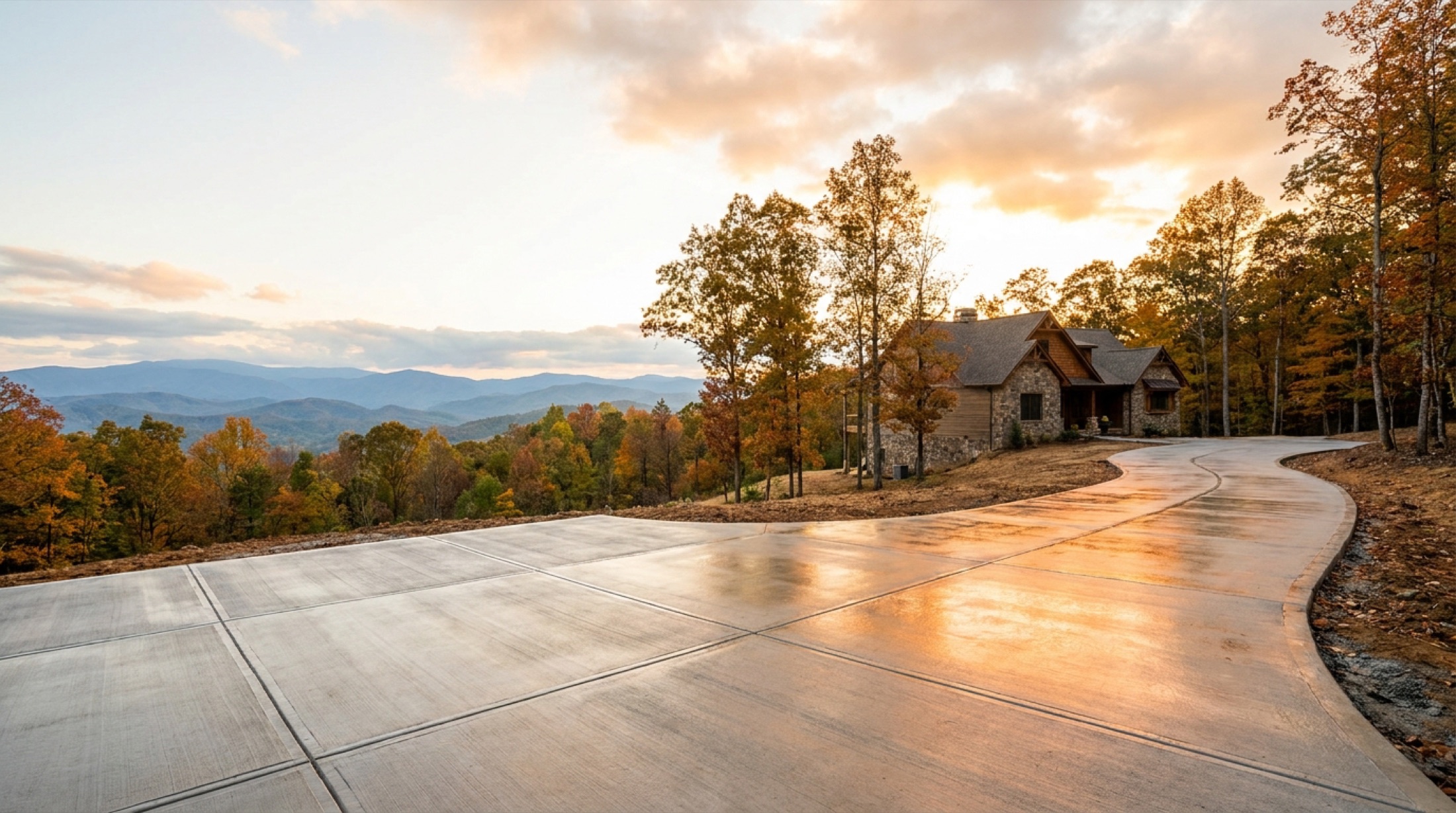
The concrete arm of a Hillsville building family
We are not a crew that got thrown together for the season. Bowman Griffin Concrete belongs to a family of building companies based in Hillsville, Virginia. Bowman Griffin General Contractors handles the building side, residential and commercial. BG Concrete Pumping is the pump. Bowman Griffin Concrete is the flatwork, the foundations and the finish work. Same family, same trucks pulling into the same yard at the end of the day.
That setup is not an accident. A building family runs into concrete constantly. Footers under a new house. A slab under a shop. A driveway that has to hold a loaded truck. Sidewalks and steps that have to look right when the job is done. Once you have poured enough of it, you either keep hiring it out and hoping, or you build the crew and buy the equipment and do it yourself. We did the second one.
The practical result for you is a short chain of command. You call one number. You talk to people who have the family name on the work. Nobody hands your pour off to a stranger and hopes it turns out. When a slab in Carroll County has our name on it, we still drive past it, and so do the people we are related to. That is a decent reason to get it right the first time.
Why we own our own line pump
Ready mix trucks are heavy and they are big. A lot of the ground around here does not cooperate. Red clay that turns soft after a rain. A backyard behind a gate. A basement floor with a house already standing over it. A driveway on Blue Ridge terrain where the truck can get to the top of the hill and nowhere near the pour. Sooner or later the concrete has to get from the truck to the forms, and the chute only reaches so far.
So we bought our own pump. It is a trailer mounted line pump, run by an operator and a hose guy, with 2.5 inch and 3 inch line. There is no boom arm on it. Other companies run boom pumps for high work and tall buildings, and that is the right tool for those jobs. Ours is the tool for ground level work in tight spots. We snake hose through gates, down side yards and around houses to reach backyard slabs and basement floors. The line size covers everything from footings to a big flatwork pour.
Most crews rent one. We own ours. Because it sits in our yard, we are not scheduling your pour around somebody else's yard or waiting on a machine to come free, and pumping is simply built into one price on our own pours. A pump usually makes sense when the pour is a foundation, when it is roughly 8 or more cubic yards, or when the truck cannot get close enough to do any good.
We do not rent it out. When another contractor needs concrete placed, we do not hand over the keys and wish them luck. We show up and do the work for them: our pump, our operator, on their pour.
Formed, poured and finished by our own crew
The pour itself is only the loud part. Most of what decides whether concrete lasts happens before the truck ever backs in, and after it pulls out. We do all of it in house, start to finish, with the same crew on the job from grading to the last pass of the trowel.
Concrete in this part of Virginia has to survive freeze and thaw, and it has to sit on soil that moves. So we spec the strength to the load and the conditions, commonly a 4,000 PSI air entrained mix built for Virginia winters. Air entrainment gives the water somewhere to go when it freezes. That is not a fancy upgrade. That is what keeps a driveway from scaling apart a few winters in.
The finish work is the part people see, so it gets the time it needs. Joints get cut on schedule, not when somebody remembers. Edges get run. Slope gets checked before the concrete sets, not after, because water that ponds against a foundation is a problem you live with for years. When we leave, the site is cleaned up and the material we brought in leaves with us. Here is the order of work on a typical job.
- Grade and a compacted stone sub base, so the slab sits on something that will not settle out from under it
- Forms set square and set to a slope that drains water away from the house, not toward it
- Reinforcement placed and supported where it belongs in the slab, not laid on the ground and forgotten
- A mix specified for the job, commonly 4,000 PSI air entrained for freeze and thaw
- Placement by chute or by our own line pump, whichever one gets the concrete where it actually needs to go
- Screed, float and the finish the job calls for: broom, smooth, or stamped and colored
- Control joints cut on time, not whenever somebody gets back around to it
- Cure, then clean up the site and haul off what we brought in
The work we take on
We work residential and commercial, and the standard does not change between the two. A homeowner's patio gets the same sub base attention and the same joint layout as a commercial pad. A fair amount of what we do is replacement work: breaking out a driveway that has cracked and settled past fixing, hauling it off, rebuilding the base and pouring it back right. Decorative work is on the list too, stamped and colored, and it is poured on the same base and jointed the same way as any other slab. Pretty concrete that was not prepped is still concrete that fails.
What we pour:
- Concrete driveways, including tear out and replacement of old ones
- Patios, walkways, sidewalks and steps
- Garage floors and shop slabs
- Slabs and foundations
- Footers and poured walls
- Stamped and decorative concrete
- Commercial flatwork
- Concrete pumping with our own trailer line pump
Numbers on paper before anybody pours
Estimates are free and we do them the old fashioned way. We come out to the property, measure the actual work, look at access and grade, and talk through your options while we are standing there. Thickness, reinforcement, finish, joint layout, where the water is going to go. Then you get a clear written quote, usually within a day or two.
If you just want a rough idea over the phone before anybody drives anywhere, call and ask. We will talk ballpark. We will not pretend a number over the phone is a quote, because we have not measured it yet and access matters more than people expect.
The written quote is what we hold ourselves to. It is itemized, so you can see what you are paying for instead of staring at one lump number. We also stand behind our workmanship with a warranty in writing, and the exact terms are confirmed on your written estimate so there is nothing to argue about later.
The country we work in
Hillsville is home. From here we run anywhere inside about a one to one and a half hour drive. That covers Carroll, Grayson, Wythe, Pulaski, Montgomery and Floyd counties, up into the New River and Roanoke valleys, and across the North Carolina line into Mount Airy and Surry County. The I-77 and I-81 corridors and the US-52, US-58 and US-221 routes are our daily roads.
Working one region for a living teaches you things a price sheet will not. Red clay behaves differently than the sandy ground crews deal with farther east. Gravel driveways are common in the county, which means a lot of our driveway work starts as a tear out or a first time pour over stone rather than a simple replacement. Winters here run through freeze and thaw over and over, so the mix and the joints matter more than the shine on day one.
Not sure if you are in range? Call and give us the address and we will tell you straight.