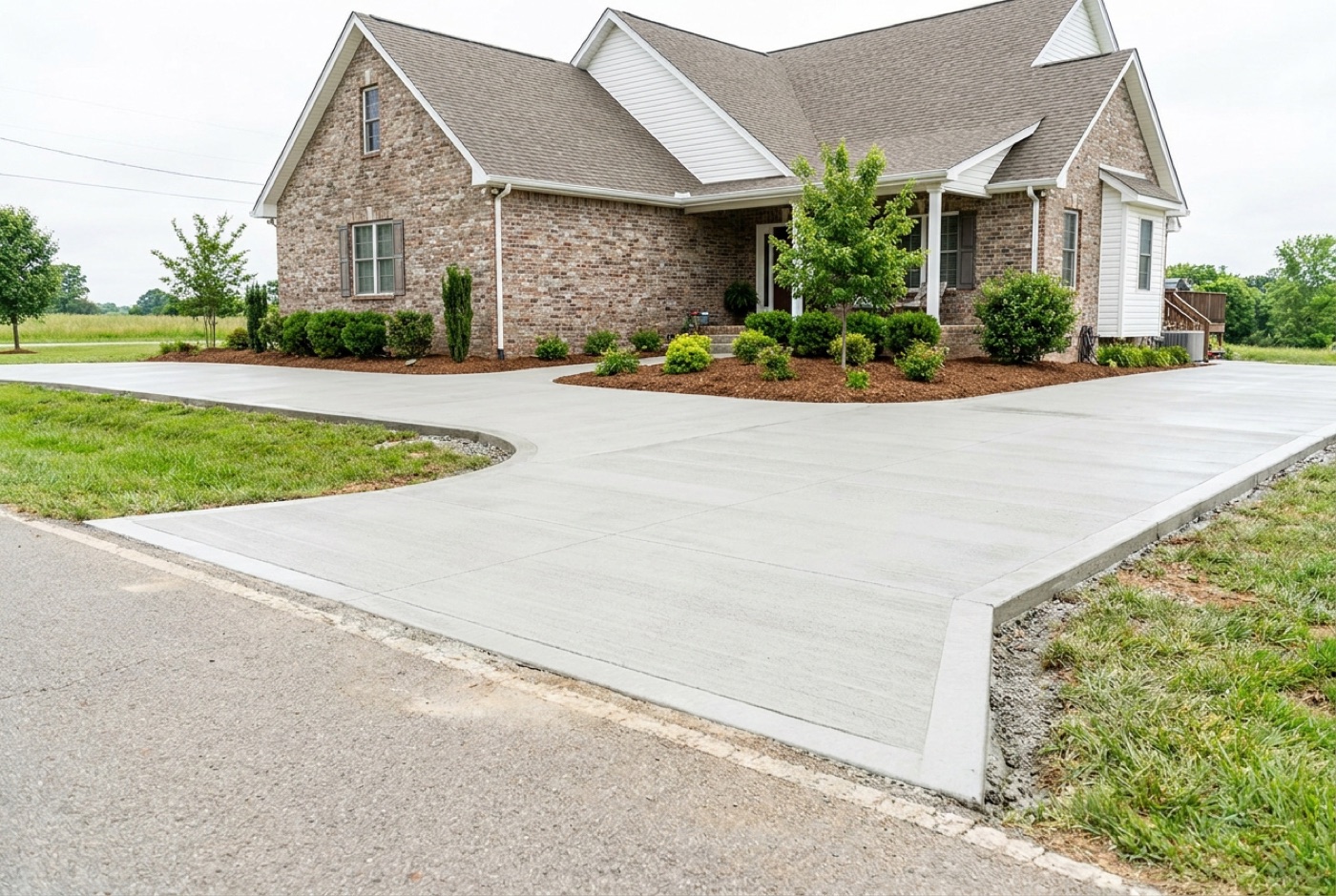
Gravel moves. Concrete stays put
Most driveways around here started as gravel, and gravel works until it doesn't. Rain moves it downhill. Tires push it into ruts and washboard. The low spots hold water, the water freezes, and by spring you have mud where the stone used to be. Every plow season takes another layer with it, and every couple of years you are paying for more stone to put back what the weather hauled off.
Concrete does not wash out. It does not rut, it does not need topping off, and a plow blade rides over it instead of digging into it. You get a hard, flat surface you can park a truck on, roll a jack across, let kids ride bikes on, and shovel clean in one pass. That is why gravel to concrete conversions are the single most common driveway job we do in this county.
Asphalt is the other thing people compare against, and it looks good the first year. Then the freeze-thaw cycle goes to work. Water gets into the surface, freezes overnight, expands, and opens the crack a little wider. Blue Ridge winters run that cycle over and over, and asphalt softens again in July heat. Concrete handles both ends of that better. Spec the right mix, put it on a base that drains, cut the joints where they belong, and it holds up for the long haul.
Red clay is the other local factor. Clay holds water and swells, so the base under the slab matters as much as the slab itself. A driveway poured straight on raw clay is going to move. That is a prep problem, and prep is where we spend the time.
What a full driveway job includes
When we quote a driveway, we are quoting the whole job, not just the concrete. Here is what actually happens on site, in order.
None of that is optional in our book. Skipping the base or skipping the joints is how a driveway ends up cracked and settled in three years. We would rather do it once.
- Layout and excavation. We stake the shape, strip sod and soft topsoil, and cut the grade so the finished surface sheds water away from your house, garage or shop.
- Compacted stone base. Crushed stone goes down and gets compacted in place. The base gives the slab something firm and free draining to sit on, which matters a lot on clay ground.
- Forms. We set and stake forms to hold the shape, the thickness and the slope. Straight lines stay straight and curves stay smooth.
- Reinforcement. Wire mesh or rebar on chairs, tied on a grid and held up in the slab where it does its job instead of lying on the ground.
- The pour. Ready-mix goes in, gets screeded to grade, floated, and worked until the surface is flat and true.
- Broom finish. A broom drag across the surface gives you traction for wet weather, snow and a sloped approach. It is the right finish for a driveway.
- Control joints. We cut or tool joints on a spacing that fits the slab so shrinkage cracks happen in the joint line where you will not notice them.
- Cleanup. Forms come out, the edges get backfilled, and we haul our mess off your property.
Thickness and reinforcement
Four inches is our standard driveway thickness, and for a car, a pickup and normal household traffic it is the right call. Where the loads get heavier we go thicker. If you are parking a dump truck, a loaded trailer, an RV or a piece of equipment, tell us at the estimate and we will thicken the slab in those areas rather than hope four inches holds.
Reinforcement is a real choice and it is worth understanding. Wire mesh is the common option and it works, as long as it is pulled up into the slab instead of left flat on the stone. Rebar tied on a grid is the upgrade. It gives the slab more strength across soft spots and holds the two sides of a crack together if one ever opens. On long driveways, on fill, on anything with a slope, or anywhere heavy vehicles are going to sit, rebar earns its keep.
Mix matters too. We spec strength to the load, commonly a 4,000 PSI air entrained mix built for Virginia freeze-thaw. The air entrainment is the part people do not think about: those tiny air pockets give freezing water somewhere to expand instead of pushing the surface apart. It is a big part of why a properly specified slab still looks right after a run of hard winters.
The apron and the approach get their own attention. The stretch where you leave the road and the stretch in front of the garage take the most abuse, so that is where thickness and reinforcement pay off first. Ask about the road end separately when the address sits on the North Carolina side of the line, where a new entrance runs under NCDOT's driveway entrance rule instead of Virginia's. Virginia's own version is explained in what a VDOT entrance permit is.
What a concrete driveway costs
Straight numbers, so you have something to work with before we ever come out. Driveways are 4 inches standard, $8 to $12 per square foot installed. That range is real, and where your job lands inside it comes down to a handful of things we can look at together on site.
Reinforcement and demolition are the two add-ons that move a driveway number most. A rebar upgrade adds $0.75 to $1.25 per sq ft over wire mesh. Tear-out of old concrete adds $2 to $3 per sq ft, because that is machine time, labor and hauling on top of the new work.
Rough numbers by phone are fine, and we are happy to talk through a ballpark before you commit to anything. But we measure on site. Every job gets a free written estimate: we come out, measure, talk options, and hand you a clear written quote, usually within a day or two. Everything is on the paper, including the workmanship warranty in writing, with exact terms confirmed on your written estimate.
- Size and shape. Bigger pours are more efficient per foot. Odd shapes, tight curves and lots of edge work take more form time.
- Access. If a mixer truck can back right up to the pour, that is the easy version. Tight gates, steep grades and long carries change the plan.
- Tear-out. Removing an old cracked slab is a separate line of work from pouring the new one.
- Thickness. Going past 4 inches for heavy vehicles adds concrete and adds cost.
- Reinforcement. Wire mesh versus a tied rebar grid.
- Site prep. How much dirt has to move, how much stone the base needs, and what the drainage situation looks like.
How the job goes
First we come out and look. We measure, walk the grade, check where water runs, look at how a truck would get in, and talk about what you actually want. Then you get the written quote. No pressure and no salesman follow-up campaign.
When you are ready, we schedule around the weather and the ready-mix plant. A typical residential driveway is a few days of work, not weeks. Excavation and base prep come first, forms and reinforcement go in next, and the pour itself is one hard day with the whole crew on it. Finishing happens the same day the concrete goes down, because that is how concrete works. Once it is placed, the clock is running and you finish it when it is ready, not when it is convenient.
Joints get cut on schedule after the pour, then forms come off. Then it is cure time, and cure time is not optional. We will tell you plainly when you can walk on it, when you can drive a car on it, and when it is ready for anything heavy. Those numbers depend on the mix and the weather, so we give you the real ones for your pour.
We form, pour, pump and finish with our own crew. Nobody gets subbed out to a stranger halfway through your driveway.
When the pump comes out
Some driveways a mixer truck can pour straight into the forms. Plenty of them around here, it cannot. The lot is steep, the approach is soft, there is a gate, a retaining wall, a septic field, a finished lawn you do not want a ten wheeler parked on, or the pour is a hundred feet back behind the house.
That is what our pump is for. We run our own trailer line pump with an operator and a hose guy, on 2.5 inch and 3 inch line. The hose snakes around the house, through a gate, up a bank or down a side yard, and the concrete gets placed exactly where the forms are. No wheelbarrow relay across your yard, no truck ruts in the grass, no compromise on where the driveway goes because of where a truck can park.
Most crews rent one. We own ours. Because we own it, pumping is built into one price on our own pours instead of showing up as a surprise line item. It also means we are not waiting on somebody else's schedule to get your driveway poured.
A pump is typically the right call when the pour is a foundation, roughly 8 or more cubic yards, or the truck simply cannot get close.
The first 30 days
New concrete keeps gaining strength for a long time after it stops looking wet. The first month is when your habits matter most. Keep vehicles off until we tell you it is ready, and when you do start driving on it, ease onto it instead of cutting the wheel while sitting still. Turning tires on a young slab scuffs the surface.
Stay off the edges. The outside eight inches or so is the most vulnerable part of any slab, so keep truck tires and trailer wheels from riding the lip until it has had time. Do not park heavy equipment or a loaded trailer on it in the first month unless we poured it thicker for that.
Skip the de-icing salt the first winter. Deicers pull water into the surface and drive the freeze-thaw cycle harder than the weather does on its own. Sand gives you traction without the chemistry. After that first season, use them sparingly.
Keep water moving away from the slab. Downspouts should discharge past the edge, not alongside it, and gutters that dump right at the driveway edge will undercut the base over time. Sealing is optional and we will tell you honestly whether your slab needs it. If a joint ever opens up or you have a question two years down the road, call us. We answer the phone for the driveways we poured.