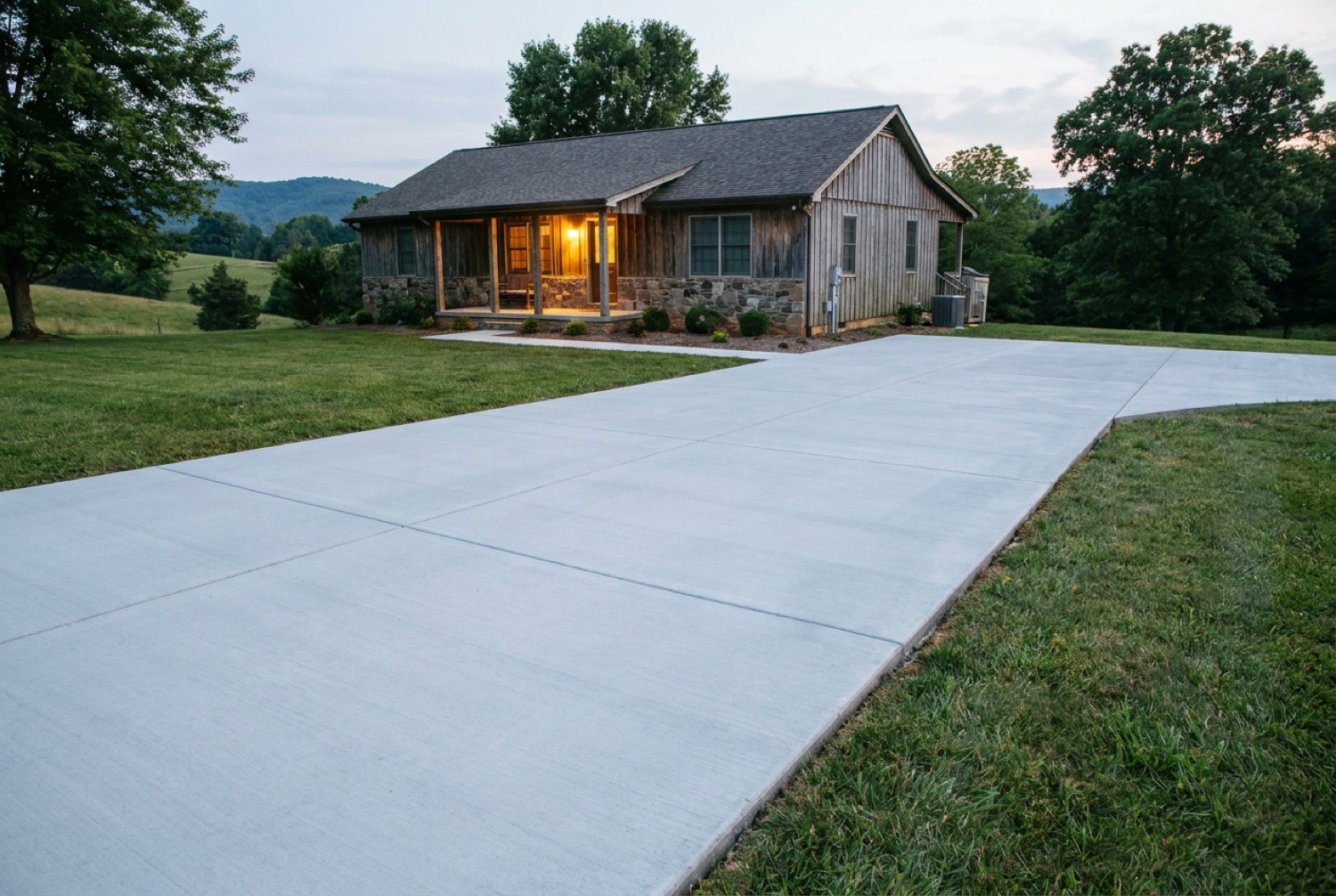
The chore that finally ends it
Ask anybody who converted and you get a maintenance story, not a design story. A gravel drive is a small private road and you are the road crew. It gets dragged in spring, it gets a load of stone when the tracks go deep, and somebody has to be there to spread it.
Potholes are what wear people down, because they come back in the same places. A dip in the same curve, a soft patch at the bottom of the grade. You fill them and the next wet spell finds them again. The other half of the trigger is everybody else who uses the drive: the propane truck, the appliance delivery, the contractor pulling a trailer. Some of them will call from the road and say they are leaving it at the end.
Then there is what the drive brings indoors. Wet stone carries clay, and clay comes in on boots, paws and the cuffs of jeans. Summer is the same problem with the water taken out. The far end costs you as well, because tires drag stone out of the entrance every time somebody pulls onto the road, and paving the apron stops that at the source. Paving that entrance carries a permit question of its own when the drive meets a state road in North Carolina, and the NCDOT driveway rule is where that one gets answered.
What happens to the stone you already own
You have been buying stone for years, so a fair question sits under every conversion. Does any of it count for anything now? Some does, and it is not the part sitting on top.
A drive that has been used hard carries three materials in three places. In the wheel tracks the stone is thinnest and pressed full of clay worked up from below. Down the middle it runs deeper but is laced with whatever grew there and got ground in. Along the shoulders is where the good material went, pushed out of the tracks by tires and by a blade.
So the walk at the estimate happens with a bar and a shovel. We open the drive in a few spots to see how deep the stone runs and what sits under it. Anything deep and reasonably clean goes back into the base and saves you buying it twice. Anything with clay through it has to leave, because it will not tighten under a compactor.
The surplus does not automatically leave the property either. Years of spreading has made most stone drives wider than the concrete needs to be, so reclaimed material goes to the shoulders alongside the new slab, the ground behind a shop, or the stretch you are keeping in gravel.
Years of traffic already did part of the work
Here is the part that works in your favor. Building a slab on an existing drive usually starts from better ground than cutting a new one across a pasture, because everything that has driven up it for a decade or two has been consolidating what lies underneath. The routing is settled too, and you have watched where the water goes rather than guessing at it.
Consolidated is not uniform, though. The weak places announce themselves: the spot that potholes every March, the section that goes soft after a wet week. Those get opened up and rebuilt rather than covered over, because a weak pocket under a slab is what cracks it in the third winter.
Culverts, ditches and where the water crosses
A gravel drive behaves like a sponge and a concrete one behaves like a roof. Rain that used to soak into a long stretch of loose stone now stays on the surface, gathers as it travels, and arrives downhill all at once. So we walk the water before we talk about forms. Which way the ditch runs, and whether there is a pipe underneath where you cross it, or whether you need a culvert under the driveway at all. If there is, its condition and how much cover sits over it both matter before a slab goes on top. A ditch line that has silted in gets opened back up as part of the job.
The shape itself gets set once in the forms and then it stays, which is most of the appeal after years of rebuilding a crown every spring. Cross slope carries water off the edge instead of letting it stand, and the length is pitched so runoff heads for the ditch and away from the buildings. Standing water is what shortens a slab's life at this elevation, and it is the same reason the concrete is a 4,000 PSI air-entrained mix built for Virginia freeze-thaw.
Long runs, and where a full length pour stops making sense
A long private run is a different question. Out there the drive would be the largest single piece of concrete on the place, and the size by size arithmetic for that lives on our driveway cost page. What belongs here is the pattern most of these follow: pave where the traffic concentrates, leave stone where it does not.
Traffic concentrates in three spots. The apron at the road, where every vehicle turns. The parking and turning area at the house, where vehicles sit and spin a wheel. And the approach to a garage or shop door, where the mud gets carried indoors. The straight middle stretch, driven over at speed and never parked on, is where gravel gives you the most for your money.
Staging is the other version of the same answer. Pour the house end now and form it to a clean square edge so a later section keys into it. You will see the joint and the colors will not quite match, and both beat a thin slab stretched over the whole run.
Access decides how any of it gets placed out there. The concrete often has to travel the last stretch without the truck, because a soft shoulder, a steep pitch or a wet spring keeps a loaded mixer off the ground it would have to cross. We run our own trailer-mounted line pump with an operator and a hose guy, on 2.5 inch and 3 inch line, so the hose goes down the bank or around the back. Most crews rent one and bill it separately. Because we own ours, placement sits inside one price on our own pours.
The honest case for staying on gravel
There are drives we look at and tell people to keep the stone, and we would rather say it standing in your driveway than take the job. Length is the first case. Past a certain run the number stops being proportionate to what the property gets back, and the same money spent on base, an open ditch and a paved apron leaves you further ahead.
Heavy farm and equipment traffic is the second. A loaded feed truck, a tracked machine coming off a trailer, or a tractor turning on the same corner every week is more than standard four inch flatwork is built to take. That can be built for, with more thickness and steel tied through it, but it is a different job at a different number.
Budget is the third. A thin slab on a thin base is worse than good gravel and it will tell you so inside a few winters. If your budget only buys the cut down version, keep the stone one more year, put the money into base and drainage, and pour it properly later.
What a conversion runs
Concrete driveways in this part of Virginia run $8 to $12 per square foot installed at our standard 4 inch thickness. Real sizes, cubic yards and ready mix loads are worked all the way through on our driveway cost page.
Two things are specific to a conversion. It starts from a better place than a replacement does, because there is no old slab to break out and haul away, so that line is not on your paperwork. What pushes the other way is dirt: how much stone has to leave, how much grade gets reshaped, and what turns up under the soft spots.
So we come out, measure and walk the length of it with you. You get it in writing, at no charge, usually within a day or two, including the workmanship warranty in writing, with exact terms confirmed on your written estimate.