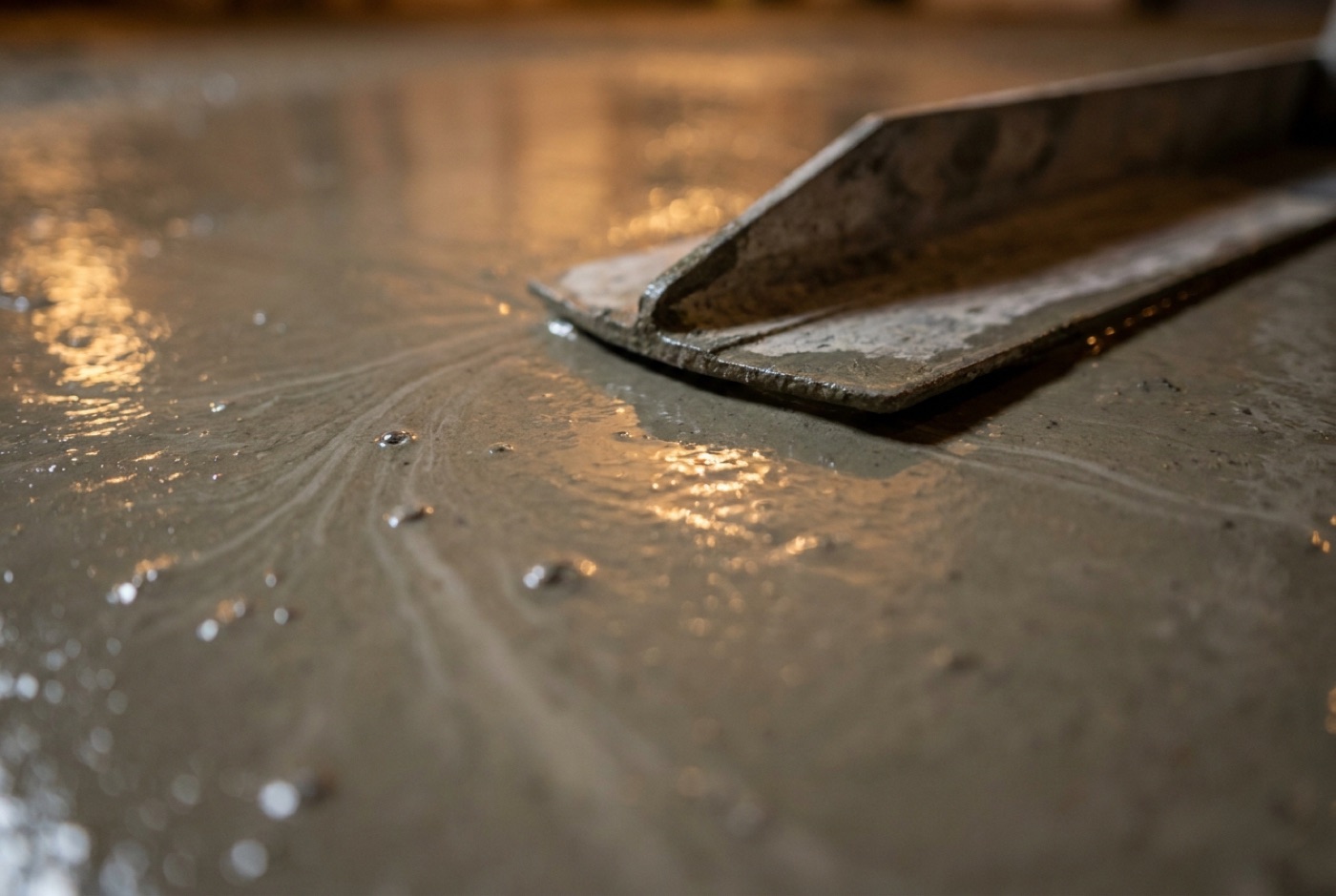
The first two days: curing is still happening
Concrete does not dry the way paint dries. It cures, a chemical reaction between the cement and water that keeps building strength for weeks, not a process of water simply evaporating away. The faster that surface moisture disappears in the first day or two, especially in sun and wind, the weaker and more likely to dust or crack that top layer ends up.
That is why the first two days matter more than people expect. Keep the surface out of a hard rain if you can, and keep sprinklers, hoses, and heavy foot traffic off it. We give you guidance specific to your pour and the weather it went down in, because a slab poured in August cures differently than one poured in January, ask us if you are not sure what your slab needs right now.
Control joints get cut within that first day too, and the timing is not cosmetic. Concrete is already shrinking slightly as it cures, and a joint cut early gives that shrinkage a straight line to open along instead of a random crack somewhere you would rather not see.
When to walk on it, when to drive on it
Most new concrete is fine to walk on somewhere between 24 and 48 hours after the pour. That is early. The slab is nowhere near full strength yet, it has simply firmed up enough that light foot traffic will not leave a mark or disturb the finish.
A car is a different question. Plan on keeping vehicles off a new residential driveway for roughly a week. Concrete keeps gaining strength well past that first week, so heavier loads, trucks, trailers, campers, and equipment should wait until the slab is close to full strength, which lands around the 28 day mark, unless we built that particular slab thicker for the load you told us about ahead of time.
When you do start driving on it, ease onto the slab rather than turning the wheel while the vehicle sits still. A tire that pivots in one spot scuffs a young surface in a way that rolling straight onto it does not. Keep truck and trailer tires off the outside edges too, those are the thinnest, least supported part of any pour.
Treat these as typical ranges, not a promise for every pour. Weather, mix, and thickness shift the exact timing, and we give you cure guidance specific to your slab when we walk it with you at the end of the job.
Hairline cracks at the joints are the slab doing its job
A thin crack that shows up running along a control joint is not a defect, it is the plan working. Concrete shrinks a little as it finishes curing, and the ground under it moves a little with the seasons, so that stress has to go somewhere. Joints are cut in specific spots so the crack lands in a line you already agreed to instead of wandering across the middle of your driveway or patio.
What is worth a second look is different: a crack that runs away from the joint line across open concrete, one wide enough to catch a fingernail, or one where you can feel a step between the two sides. That points at something happening under the slab rather than normal shrinkage at a joint, and it is worth a call.
What can stain new concrete while it is still green
Concrete is at its most porous in the first few weeks, before it has fully cured, so anything that sits on the surface has a better chance of soaking in than it will later. None of this ruins a slab structurally, but a stain that soaks into green concrete is harder to lift than one on concrete that has already cured. Keeping the surface swept off and moving anything that can drip or leak instead of parking it there for a month goes a long way. A few common culprits worth watching for:
- Oil, gas, or fluid drips from a vehicle or mower left parked on it
- Fresh mulch, leaves, or fertilizer, which can leave tannin stains
- Rust from metal furniture legs, planters, or tools left sitting on the surface
- Grass clippings or leaves left to sit and decompose on a damp slab
Why de-icing salt has to wait through the first winter
If your slab goes down near winter, or has to make it through its first one before it turns a year old, leave de-icing salt out of the picture and reach for sand for traction instead. Salt pulls water into and out of the surface faster than a normal freeze and thaw cycle would on its own, and concrete that has not finished curing feels that harder than an older slab does.
That matters more here than it would somewhere flatter and warmer. At this elevation the freeze thaw cycle is a real, repeated event over a winter, not an occasional cold snap, and it is already working on exposed concrete without help from salt. Give the slab its first full winter to finish curing before salt goes near it, and lean on sand for grip in the meantime.
Sealing: when it helps, and when to leave it alone
Sealing is not something every slab needs right away, and putting it on too early can trap moisture the concrete is still trying to release as it cures, working against you instead of for you.
Where sealing earns its keep is on surfaces that see the most exposure, stamped and decorative work especially, and any slab where you want to cut down on staining. A broom finished driveway or walkway can often go without and hold up fine for years. If sealing makes sense for your pour and finish, we will tell you when the slab is actually ready for it rather than guessing at a date.
What is worth a call
Most of what you notice in the first month is normal and does not need a call: a hairline crack at a joint, a little dust the first time you sweep it, small color variation as it cures. Call us about anything that looks like it is happening under the slab rather than on top of it, the kind of thing on this list.
- A section of the slab that has visibly settled or sunk compared to the rest
- A crack that is wide, runs away from a joint, or has one side sitting higher than the other
- Standing water on the slab that is not draining the way it did right after the pour
- Anything that does not match the cure guidance we gave you for your specific pour
Backed by the warranty in writing
Settlement over a base we prepared, or a finish issue that traces back to our crew, is on us to fix. There is a workmanship warranty in writing on your original estimate, and the terms on that page are what we stand behind. If something looks off in that first month, call before you decide it is nothing. It costs you nothing to ask.