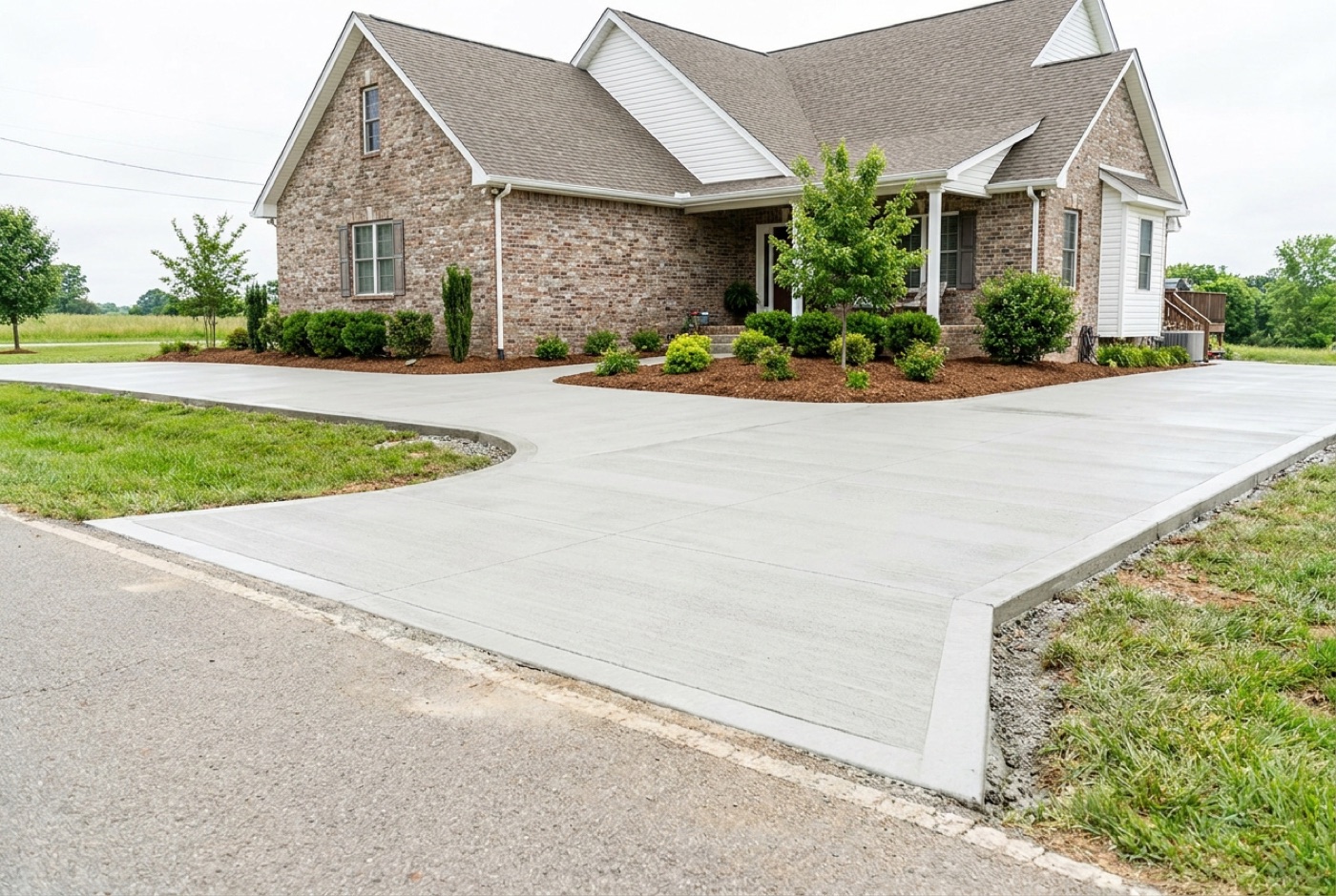
Circular, horseshoe, and why the difference matters
The names get swapped in the same sentence around here, so here is the version worth using. A circular drive leaves the road at one entrance, swings around an island of lawn or planting, and comes back out that same connection. A horseshoe uses two separate entrances, so you pull in at one end of the frontage and out the other and never put the vehicle in reverse. What matters for planning is not the word. It is the count of entrances and the size of the curve.
The entrance count is the first fork. One entrance is one connection to the public road. Two is two, and entrance work on a state maintained road takes its own approval from VDOT, whether you are adding a second connection or reworking the one you already have, separate from whatever the county wants to see on the concrete itself. Our Virginia permit guide walks through who to call, and the answer on driveway permits in Virginia takes the two desks one at a time. Ask early, because designing a whole layout around a second entrance you have not confirmed is a rough way to find out.
Frontage decides much of the rest. A horseshoe wants width along the road, entrances far enough apart that a vehicle leaving one is not in the path of the other, with sight lines you can see down both ways. A narrow lot, a bank along the front, a ditch line, or a curve in the road usually pushes the answer toward a single entrance loop.
Turning radius is the design
Two numbers run a loop. The inside radius is the distance from the center of the island out to the edge of concrete on the island side. The outside radius is that plus the lane width. A 15 foot inside radius with a 12 foot lane gives a 27 foot outside radius, so the loop needs about 54 feet of clear yard across its widest point before you add the approach in from the road. Tighten the inside radius and you pinch the driver. Open it up and the island grows into the room you wanted for the lane.
The number that matters is your vehicle, not the average one. A sedan comes around short and forgiving. A crew cab pickup wants noticeably more. A pickup with a bumper pull trailer wants more again, and the trailer will not track the arc the truck does. So we stake it before anybody builds a form: stakes, string and marking paint on the grass, then you drive the loop at walking speed in what you actually own while we watch where the tires track. Paint on grass costs nothing. Recutting a radius in cured concrete is a tear out.
- Outside radius equals inside radius plus lane width. Doubled, that is the yard the loop consumes.
- Lay it out for the largest vehicle that uses it regularly, not the one parked there today.
- A trailer swings inside the tow vehicle's line, so it needs a wider inside edge than the truck alone.
- Stake it and drive it before forming. It is the last cheap change on the job.
Lane width through the curve
A vehicle sweeps a wider band on a curve than on a straight run, because the rear wheels follow a tighter arc than the front ones. A lane width that feels generous on a straight drive up to the house feels tight the moment it bends, so curved sections get widened rather than held to the straight run width, and the tightest part of the arc gets the most.
Watch the edges too. Where the loop passes a front walk or a porch step, leave room to open a door without standing in planting. And think about the vehicles that are not yours, a fuel truck, a moving van, an ambulance. A loop laid out around one car can trap something bigger with no room to back out.
The island, and where the water goes
The island is the piece people plan last and regret first. A loop wraps a piece of ground, and if the concrete slopes inward from every side you have built a basin with no outlet in the middle of the front yard.
So the grade gets settled before the shape gets pretty. Concrete sheds away from the house and off the outside edge of the loop, and the island gets its own way out, a low corner, a shallow swale, or a pipe under the drive to daylight. Red clay holds water and swells when it takes on more, and an island that stays saturated works on the slab edge beside it through every freeze and thaw we get up here. Two smaller calls to make early: keep the island wide enough that a mower can turn inside it, and keep anything with a serious root system back from the edge.
What the shape does to forming, joints and yardage
Shape does not change square footage, so measure the ribbon and not the circle. Run a tape along the centerline of the lane the whole way around, then multiply by the lane width. Outer diameter tells you how much yard the loop eats, not how much concrete you are buying.
Work one through. Say the centerline measures 100 feet around and the lane runs 12 feet wide. That is 1,200 square feet of driveway. At the driveway range that is $9,600 to $14,400 installed, confirmed on your free written estimate. At 4 inches, with the 10 percent waste allowance on, that works out to 16.3 cubic yards, a two load pour. Our driveway cost page runs the yardage arithmetic step by step, along with the pricing picture and the add ons.
What curves genuinely add is form work and edge, not area. Straight lumber does not bend, so curved edges get formed with bendable stock staked much closer together, and there are more linear feet of form and more edge to finish per square foot of slab than on a plain rectangle. Joints matter more here too. Control joints on a curve get cut radially, square to the edge, and spaced so panels come out close to square instead of long thin wedges. A wedge shaped panel cracks where it wants to rather than where you cut it, and on a curve that shows from the road.
Getting concrete to the far side of a loop
Access on a loop is not access on a straight drive. The mixer truck serves the entrance and the first stretch off the chute without trouble. The far side of the loop, the back of the island, and any leg that runs behind the house is where chute reach runs out, and there is no shortcut across the middle, because nobody is driving a loaded truck over new forms or across an island bed you are about to plant.
That is the ordinary trigger for the pump: a foundation, roughly eight or more cubic yards, or a lot too tight for a chute. The loop above lands at 16.3 yards, so it clears that on volume before access even enters the conversation. We run a trailer mounted line pump with an operator and a hose guy, on 2.5 inch and 3 inch line, so the hose goes around the far side while the mixer truck stays on solid ground near the road. The pump is ours, so its hours sit inside the square foot number instead of turning up as a separate charge from another outfit.
What we look at when we come out
On a circular or horseshoe layout the site visit does more work than usual. We walk the frontage, look at sight lines both directions, work out where an entrance can reasonably land, stake an inside radius, and have you drive it. We check the grade and decide where water will run once there is a loop of concrete in the way. What comes back to you, a day or two after that visit, is a free written estimate that reads the staked loop back in its own terms: the inside radius and the lane width we marked, how many entrances and where each one meets the road, how the island gets graded and where its water leaves, then thickness and reinforcement, and the figure. Nothing is owed for the visit or the page. The workmanship warranty is in writing on that same page, with the exact terms confirmed on your written estimate.