What a wheelbarrow pour actually looks like
The truck parks as close as it can get, the chute swings out, and the concrete lands in a barrow instead of in the forms. Everything after that is people. Somebody wheels a loaded barrow across the yard, up a plank ramp over the form board, and dumps it where the crew calls for it. Then he turns around and goes back for the next one. It is how concrete got placed for a very long time, and on the right job it still works fine.
What gets underestimated is the arithmetic. Ready-mix arrives in 10 cubic yard loads and a contractor barrow carries a small fraction of one. Count the round trips it takes to empty a single truck and the number is bigger than anybody guesses standing in the driveway beforehand. Then remember there is another truck behind it, and that the trips get harder as they go: ground already rutted, a plank that has shifted, a ramp slick with spilled paste, and men who have been at it a while.
The clock is the real difference
Concrete is a chemical reaction on a timer, and the timer starts at the plant rather than on your site. There is a working window between the load being batched and the point where the mix is too stiff to place and finish properly. A pump does not stretch that window. What it does is stop you from spending most of it on transportation.
The trucks run their own clock at the same time. A ready-mix truck sitting on site while a barrow crew works through the drum is on the plant's clock and not doing anything else, and on a hand-placed pour of any size that is worth asking your supplier about while you are still planning the day rather than after it.
With hose in the picture, the pace of the day gets set by the finishers instead of the haulers. The operator throttles the stream up or down to match how fast the crew can screed and float, so concrete shows up where it is wanted at the rate it can actually be worked. Nobody waits on a barrow, and nobody gets buried by one either.
Where hand hauling shows up in the finished slab
The strongest argument for the machine on a real pour is not speed. It is that a continuous placement makes better concrete than a stop and start one, and that difference is still there years later.
Placed in one steady pass, each new stretch of concrete lands against material still plastic enough to knit with it. Spread the same pour across hours of barrow trips and the first end can begin setting before the last end arrives. That is how a cold joint turns up in the middle of a slab that was drawn as one piece, and it is not something a finisher can trowel away.
The second risk is water, and it is the length of the pour that brings it on. When the load is stiffening in the drum and half the forms are still empty, somebody wants to loosen it up so it moves easier in the barrow. A placement that finishes inside the working window never arrives at that moment.
Then there is what a loaded barrow does underneath it. Wheel tracks across a vapor barrier, mesh and bar shoved out of position and trodden into the base, footprints in a subgrade somebody spent a day getting flat. All of it has to be reset before concrete covers it, or it does not get reset. Hose lies still on the ground and the discharge end travels in a man's hands, so the inside of the forms stays the way it was built.
The crew math nobody runs before the day
The comparison most people run in their heads is machine cost against free labor. The labor is not free, and on a residential crew it is not spare either. The same people who would be screeding, bull floating and edging are the ones pushing barrows, so the finishing crew goes thin at exactly the moment concrete is arriving fastest. You either bring extra hands for the day or you accept that placing and finishing are fighting over the same ones.
Add the hours up honestly. People on site times the length of the day, the truck time above, and putting right anything the barrow route tore up on the way. Then set the pumping line next to that total instead of next to zero. On a small pour the barrows still win. On a foundation, roughly eight or more cubic yards, or a lot too tight for a chute, it usually goes the other way, and it goes there faster on a hot day or an awkward site.
The route is part of that bill. Every trip crosses whatever sits between the truck and the forms, and on a house lot that is usually lawn, beds, a walk or a finished drive. Plank runs help and a careful crew lays them, but planks are a route rather than a cure. Hose is not weightless either, and we do not pretend it is, but it rests once, along a path picked with you before anything starts, instead of being rolled back and forth over the same strip all morning.
When a wheelbarrow crew is the right answer
We own the machine, which is exactly why this part is worth saying plainly. Plenty of pours do not need it, and when yours is one of them the estimate will say so.
- Small pours where the truck backs right up and the chute reaches the forms. If gravity is doing the work, nothing else has to.
- A few barrow loads to finish a corner the chute almost reaches. That is ordinary work on a normal pour, not a reason to bring a machine.
- Sidewalk sections, steps, small pads and post footings, where the whole job is a couple of yards and the walk from the truck is short and level.
- Hand mixed work, where there was never a ready-mix truck in the picture to begin with.
The walk that settles it, and how it lands on the estimate
There is a test you can run yourself, and it beats any rule about yardage. Stand where a loaded truck can genuinely park, walk from there to the forms with an empty barrow, then picture doing that walk loaded, over and over, for as long as the pour takes. Short, level and clear means barrows are fine. Around the house, through a gate, down a bank or across something already finished means the comparison stops being close. How the machine itself works, what our 2.5 inch and 3 inch line fits through, what a mix has to be to travel through hose, and which machine suits a given pour all have their own pages. This one is only about hand hauling against hose.
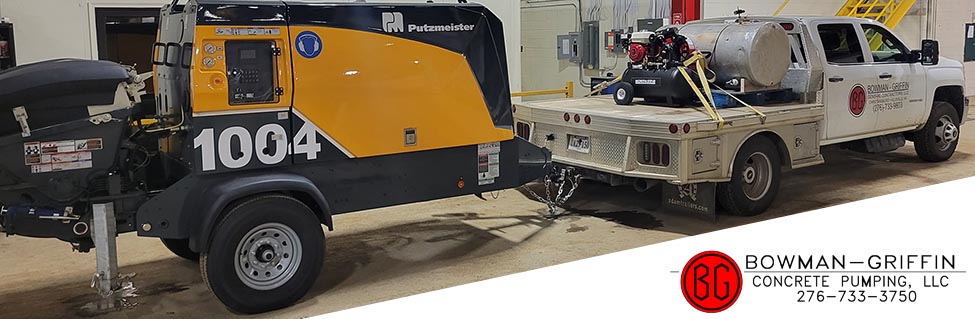
On our own work we do not sell pumping as an upgrade over your own labor. It is a placement method chosen for the site, priced inside one number for the job, and the written estimate says which method the pour is built around and why. When somebody else is doing the pouring and it is only the placing that is the problem, we sub the pumping for you, on your pour and your schedule, with our own operator and hose guy running our own line pump on 2.5 inch and 3 inch line. Your crew stays on the finish.
The useful version of this conversation happens before ready-mix gets ordered, while the mix, the truck timing and the crew size are all still adjustable. Our finished work carries a workmanship warranty in writing, with exact terms confirmed on your written estimate.