Pressure instead of gravity
Back a ready-mix truck up to the forms and the chute does the work. Concrete slides down a steel trough and lands wherever the truck can park and the trough can swing. On an open lot with a hard drive up to the forms, that is the right way to place concrete, and we say so on plenty of estimates.
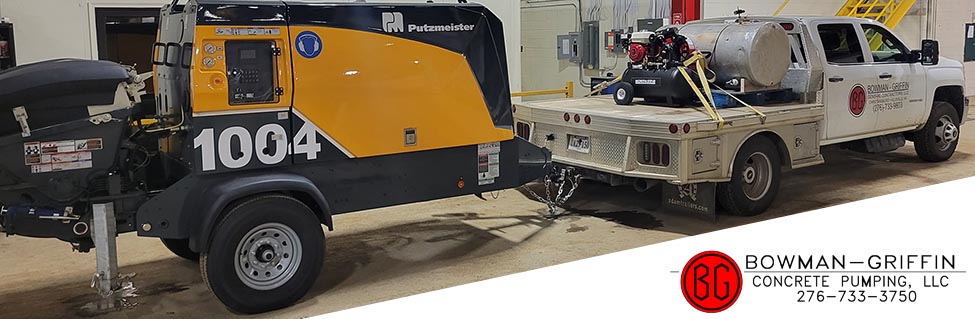
A line pump changes the last stretch of that trip. The mixer truck discharges into a hopper on the back of the trailer instead of into the forms. Inside the machine a piston draws that concrete out of the hopper and pushes it into hose under pressure. The question stops being where the truck can park and becomes where two guys can walk a hose.
The steady part matters as much as the reach. Most trailer pumps run twin pistons that alternate, one drawing a charge while the other pushes, with a valve switching between them. A paddle keeps the hopper turning over so the material does not stall or separate. The operator throttles the stream up or down to match how fast the crew is screeding.
Why line size matters
Our own line pump runs 2.5 inch and 3 inch line. Hose comes in sections that clamp together, so the layout is built to fit the site. Add sections to get around the house, pull them back off when the pour is closer than expected.
The two sizes trade off against each other. The 2.5 inch line is lighter to carry and easier to steer by hand in a footing trench, between two houses, or through a gate or door opening. The 3 inch line has more room inside, so there is less friction against the hose wall and it moves more volume with less strain on the machine.
Everything in the line adds resistance: every foot of hose, every bend, every foot the concrete has to climb. That is why the layout gets planned instead of dragged out. A good operator reads the pressure and hears the machine change note when a line starts to pack.
Laying out and walking the hose
The route gets planned and run before any concrete shows up, not while trucks sit on the clock. We walk the site, pick the spot for the trailer, and lay line from there to the forms. Bends stay long and sweeping. A sharp kink is the most common place for a line to plug.
Once concrete is moving it takes two. The operator stays at the machine, feeding the hopper off the ready-mix truck and watching pressure. The hose guy stays at the far end with the discharge in his hands, laying concrete where the finishers want it. The two of them talk the whole pour, because the man at the placing end is the only one who can see the pour getting ahead.
Placement order gets settled before the first yard goes in. On a slab we start at the far end and work back toward the way out. In a footing trench the hose goes down the line and fills it in one pass. In a basement the line comes in through a door or a window opening.
The mix has to be ordered to pump
A pump does not weaken concrete. Strength comes from the mix and the cure. What a pump cares about is whether the load was designed to travel through hose, and that conversation happens with the plant before it is ordered.
Slump is the first thing. Too stiff and the machine works itself to death pushing it. Too wet and the mix segregates in the line, the paste running ahead while the stone packs up behind it, which is how a plug starts. The plant hits the workable middle with the mix design instead of anybody adding water on site. Water added at the truck is what actually costs you strength.
Aggregate size is the second. Stone has to be small enough to travel the line with room around it, and paste content matters too, because the paste lubricates the hose wall and carries the stone along. Fiber mixes and admixtures change how a load moves, which is why we ask what is coming before pour day. For most work in this climate we spec a 4,000 PSI air-entrained mix built for Virginia freeze-thaw.
Priming and cleanout
Nothing goes down a dry line. Before concrete, a wet slurry runs through the hose to coat the inside wall so the concrete slides instead of grabbing. That first material out the end does not go in your forms. It is there to lubricate the line and nothing else. Skipping it to save ten minutes is how a pour turns into an afternoon of pulling hose apart looking for the plug.
Cleanout is the same story at the other end. When the last yard is placed, the line gets cleared, the hopper gets washed, and the washout goes in the spot agreed on before anybody started, not into a yard and not into a storm drain.
What the site needs for the pump to set up
Setup is simple, but a few things have to be true, and all of them are worth sorting out on the phone.
- Firm, reasonably level ground for the trailer, close enough that the hose route makes sense. A driveway, a road shoulder or a field edge all work.
- Room for the ready-mix truck to back up to the hopper and discharge into it.
- A clear path for the hose from the machine to the forms. Gates unlocked, obstacles moved.
- Water on site for priming and washing out, plus a washout spot picked ahead of time.
- Overhead lines, soft spots and steep grade flagged in advance, and finishers ready when the concrete is.
The pours that need one
A pump is not the answer to every pour, and we will say so when a chute reaches fine. It earns its keep when the concrete has to end up where the truck cannot follow.
- Backyards you cannot back a truck into, whether it is a gate, a fence line or a neighbor's property in the way.
- Slabs and patios that mean running line around the side of a house rather than across the lawn in front of it.
- Basement floors, walkouts and interior slabs where concrete has to go inside a wall that is already standing.
- Footings and footers, especially stepped ones on a bank, where the far corner of the trench is nowhere near the chute.
- Tight lots and long runs from the road, and any pour where getting the truck close means driving it over a septic field, a finished driveway or soft gravel.
Line pump or boom pump, the honest answer
People search this question, so here is a straight answer with nothing sold in it. A boom pump is a different machine: a truck carrying a folding articulating arm, with the concrete traveling up that arm and getting placed from above through a pipe. It sets up on outriggers and exists to put concrete somewhere high or far out over an obstacle. Multi-story decks, tall walls and very large commercial pours are what it is built for.
A line pump does not reach over anything. It goes around. Concrete travels through hose that sits on the ground, carried through a gate, laid down a bank or run through a door opening, with a man walking the discharge end to where it needs to land. Smaller setup, smaller footprint on a residential street, and the control at the placing end is in somebody's hands.
So the choice comes down to the direction the concrete has to travel, and the work in this part of Virginia is overwhelmingly around, through and down into rather than up and over. We own our own line pump and our own crew runs it. We do not own a boom pump and we are not going to pretend otherwise.