Start with the direction, not the machine
Most people come at this backwards, picking a machine first and then fitting the job to it. Turn it around. Stand where a ready-mix truck can realistically park, look at where the concrete has to end up, and describe that trip in plain words.
If the description is horizontal, the pour is a line pump job. Around the corner of the house. Through a gate. Between two houses. Down a bank into a footing trench. In a door or a window opening and out across a basement floor. That is concrete traveling at or near ground level, past obstacles that sit beside the pour rather than above it.
If the description goes vertical, you are describing a different machine. Concrete placed on an upper deck, set on top of a tall wall, or dropped over a building already standing has to be carried up and out, and an articulating arm on a truck is what the trade built for that. The trap is treating one machine as an upgrade of the other. Get the direction right and the machine picks itself.
What each machine is really solving
An arm solves a clearance problem. Something tall or wide sits between the concrete and where it has to land, and the answer is to go over the top of it. That is why it turns up on multi story decks, tall walls and large commercial pours.
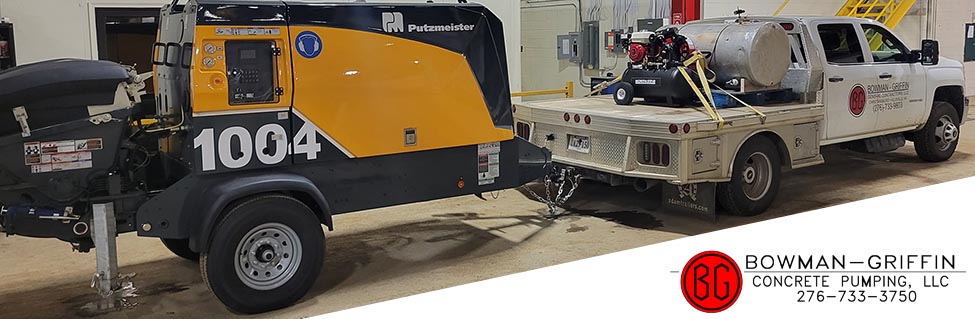
A trailer-mounted line pump solves an access problem at grade. The truck cannot reach the forms, but two people on foot can, and hose in sections goes wherever they walk it. The measure is not how high the concrete has to go, it is whether there is a clear path from the machine to the pour. Hold onto that distinction and the borderline cases settle themselves, because where the concrete lands is the question, not how tall the building is.
Setup footprint on a residential street
This is the part homeowners never think about until pour day, and on a house lot it decides plenty of jobs on its own.
An arm has to be braced. Outriggers spread out from the truck and put heavy load on a few pads, so the ground under each one has to be firm and reasonably level. On a narrow street with cars along both sides, that footprint often ends up in the road, which becomes a traffic control conversation with the locality before the date is set. Overhead utility lines and grown-out limbs matter too, because the arm has to clear what is above the pour.
A trailer pump sets up small. It parks in a driveway, on a road shoulder or at a field edge, anywhere the ground is solid and a mixer truck can reach the hopper. The rest is hose on the ground, weighing what two people can carry. None of that makes one machine polite and the other rude. It means the site gets a vote, and on a lot with narrow frontage, wires overhead and a gated back yard, it casts most of it.
- Firm, level ground under every bearing point, easier to find in a driveway than in a crowned road.
- Room for the ready-mix truck to reach the machine, not just room for the machine.
- What is overhead: service drops, phone and cable lines, limbs grown out over the street.
- Whether the setup takes travel lanes, and whether that gets arranged with the locality first.
Why the work in this part of Virginia runs around rather than up
Look at what actually gets poured inside a working radius of about an hour to an hour and a half from Hillsville. Footings and footers. Basement floors and walkouts. Garage and shop slabs. Driveways, patios and sidewalks. Poured walls. Flatwork for small businesses. That list is ground level and near ground almost all the way down.
The terrain pushes the same way. Blue Ridge lots are rarely flat and rarely square. A footing that steps its way down a bank is ordinary work in this county, and it is the clearest case there is of concrete needing to travel down and along. Long gravel drives, ground gone soft after a wet week and back yards a loaded truck has no business entering are the everyday obstacles here, and every one of them is a horizontal problem. That is why our equipment is what it is.
Reading your own job before you make the call
You can usually settle this yourself in about two minutes, standing on the site with your phone in your hand. Work through it in this order and you will know what you are asking for before anybody quotes it.
- Where can a loaded mixer truck genuinely park, not where you wish it could.
- From that spot, is the pour above the truck, below it, or roughly level with it.
- Is the obstacle sitting beside the pour, like a house or a fence, or standing over it.
- Can two people walk a clear path from that spot to the forms, gates unlocked.
- Is there anything overhead along that route or above the forms.
- Roughly how many yards. A foundation, roughly eight or more cubic yards, or a lot too tight for a chute are the common pump triggers.
What to ask a pumping sub before you book the date
Homeowner hiring one crew, or general contractor lining up a placing sub, this short list separates an outfit that has looked at your job from one that is guessing. Ask on the phone, before ready-mix gets ordered. The answers matter more than the machine, because pours go sideways when the pieces do not line up.
- Which machine are you bringing, and what about my site made you pick it.
- Where will it set up, and what does it need under it and above it.
- Who runs it, and do those people stay through the whole pour.
- What has to be ready on my side, and what stops the day if it is not.
- Who talks to the plant about the mix, and when does that happen.
- Where does the washout go, and if weather moves the date, how hard is the equipment to move.
The pours where a boom is the right machine
Here is the part with nothing sold in it. A trailer line pump is the machine we run, with our own operator and hose guy on it. There are pours it is not the tool for, and we say so on the first phone call.
If concrete has to be placed on an upper deck, set on top of a tall wall, or reached out over a building already standing, an articulating arm is doing work that hose on the ground cannot do. The right advice there is to hire an outfit that runs that equipment, and we will say so rather than talk you into a setup that fights the site all day. We would rather lose the pour on the phone than lose your morning on site.
When the concrete does have to go around, through or down, that is squarely our work. On our own pours the pumping is part of one price and one written estimate. For builders and other concrete crews, we sub the pumping for you, on your pour and your schedule, with our people on the machine. The finished work carries a workmanship warranty in writing, with exact terms confirmed on your written estimate.