How a pumped pour normally comes together
Here is the way it usually works, and there is nothing wrong with the people doing it. A builder or a homeowner hires a concrete crew. The crew walks the site, sees a backyard slab behind a gate or a foundation stepped down a grade, and knows the mixer truck is never going to reach the forms. So they book a pump from an outfit that has one. Now the job has three calendars on it instead of one.
Those three are the concrete crew, the ready-mix plant and the pump outfit. All three have to land on the same morning, in the same weather window, in the right order. The plant is scheduling trucks for everybody in the county that day. The pump outfit is doing the same with its equipment. Most of the time it works out. When it does not, it does not fail quietly.
On our jobs that middle calendar does not exist. The pump belongs to us, so booking a pour means getting two parties to agree instead of three: our own crew and the ready-mix plant. That is the whole list.
What goes wrong when the pump is the loose piece
Concrete has a clock in it. Once the plant loads the first truck, everybody standing on that site is working against that clock, and it does not pause for a phone call. That is what makes a late pump different from a late anything else.
If the outside pump runs an hour behind, the trucks are still coming, and concrete sitting in a driveway is getting older by the minute. If the pump does not show at all, the pour gets scrubbed. The load gets canceled, the crew stands down, and everybody reschedules around whatever the weather does next week. On a footing already dug open, that is not a small thing.
There is also the question of who is standing there when it happens. The crew that showed up on time is the one in your driveway explaining a delay it did not cause, and there is nobody on site with the ability to fix it. That conversation is nobody's fault and it is still your morning.
The other way it goes sideways is quieter. The pump shows up, but the man running it has never worked with that crew, does not know the mix that was ordered, and is putting line together on a site he has never seen. Concrete comes in surges instead of steady, the finishers fall behind, and the surface pays for it.
Take the outside pump out of the picture and none of that is on the table.
The pumping is part of the price, not a pass-through
When a crew has to bring in a pump, that cost reaches you as a pass-through with a markup on it, and the crew has little say in what it costs them. That is not sharp practice. It is what happens when the equipment belongs to somebody else.
We price the pump into the job. On our own pours the whole thing lands on a single written estimate from a single crew: forming, sub-base, steel, placing, pumping, finishing and cleanup. There is no separate pumping line to chase down and no second company to pay.
It also means we can tell you the truth about whether you need it. We would rather chute it straight off the truck when the truck can reach, because that is faster and cheaper for everybody standing there. When we say a pour needs the pump, it is because it does, and it is written on your free estimate before anybody starts work.
One crew, one name on the work
Split a pour between two companies and you have built a seam into the job. Seams are where the arguments happen.
If a slab comes out with a bad surface, was that the finish or the placement? If a wall got a cold joint in it, was that the crew or the line running dry? When two companies were on site, both of those questions have two answers and you are the one who gets to sort them out. When it is one crew, there is nothing to sort out. Our operator, our hose guy, our finishers, our name on the estimate.
It shows up in how the pour runs, too. The man on the hose and the men on the screed work together every week, so he knows how fast they want it and where. A steady pour is easier to finish than a stop-and-start one.
The finished work carries a workmanship warranty, terms confirmed on the written estimate.
The machine itself, and where the rest of it is written down
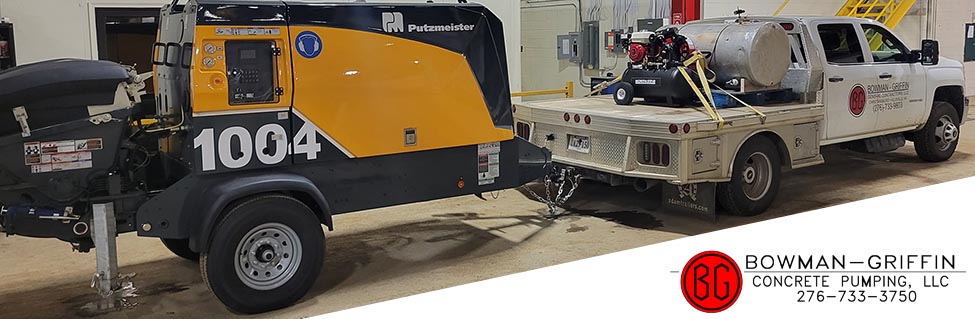
None of the above means much without saying what the equipment actually is, so here it is short. We own one trailer-mounted line pump. It gets towed to the job, parked on solid ground, and moves concrete down hose, 2.5 inch and 3 inch, that two of our people walk out to the forms. Access and yardage decide whether your pour wants it, and we settle that when we look at the site, not on pour morning. The long version, what the rig reaches, what it will not do, and which pours call for one, is written out on our pump page.
Builders and crews with their own men on the forms can put us on a date too. You hire Bowman Griffin for the placing and our people come out and do it. Nobody outside this company runs that machine, ever, so what you are booking is a crew with a pump, not a pump by itself. What we need from you beforehand and how we work around your ready-mix window are laid out on our page for builders and contractors.